Development of a cascade mathematical model for digital image processing: a systems approach
DOI:
https://doi.org/10.15587/1729-4061.2026.365662Keywords:
image processing, cascade model, Gaussian filtering, mathematical model, machine visionAbstract
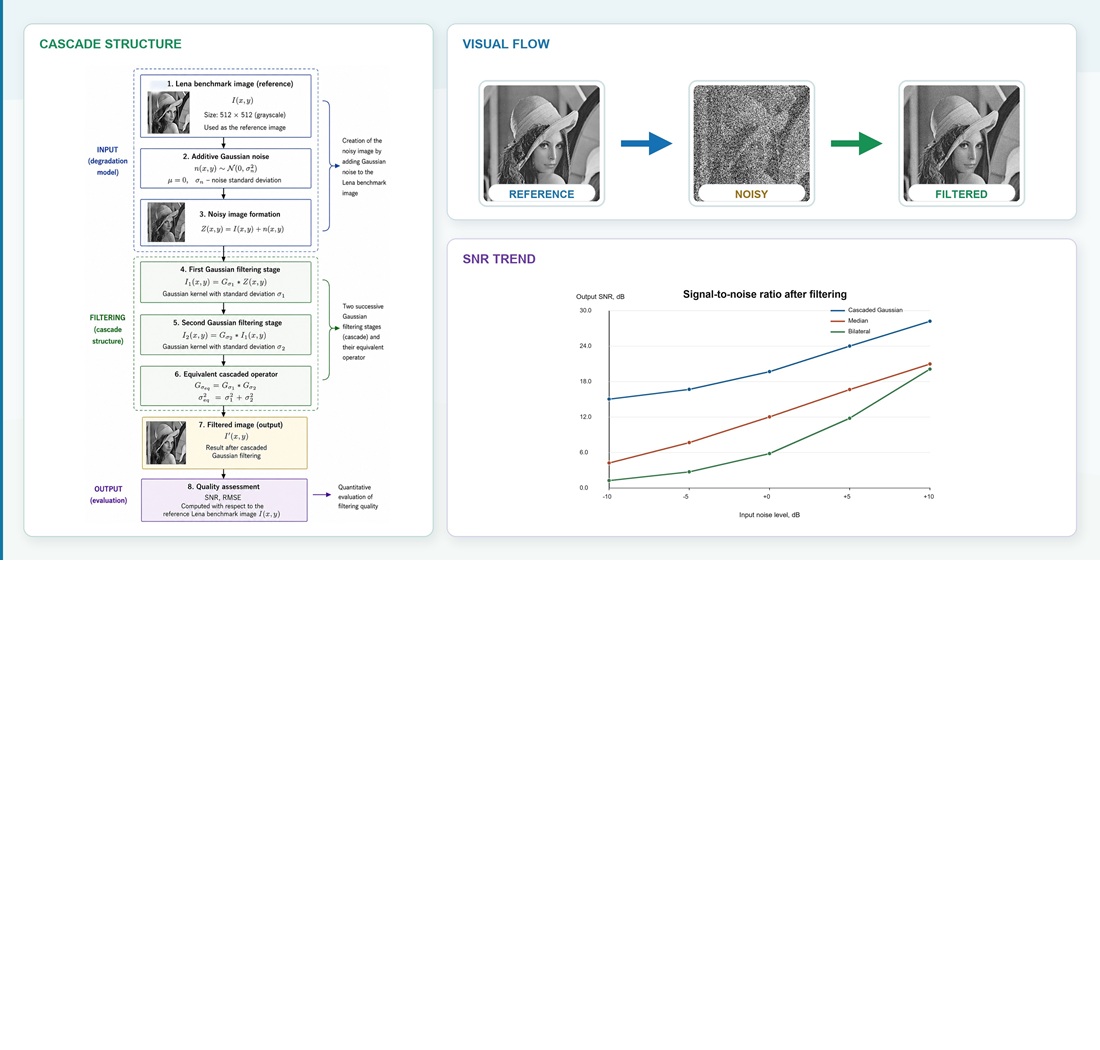
The object of this study is to preprocessing digital images degraded by additive Gaussian noise using cascaded Gaussian filtering. The scientific problem is to improve the output signal-to-noise ratio and reduce reference-based residual error of noisy digital images under additive Gaussian noise while preserving the informative structure required for subsequent image analysis. The model represents a noisy image as an additive combination of the reference image and a Gaussian noise component and describes two filtering stages through convolution of Gaussian kernels. The model is tested on the Lena benchmark image at noise levels from –10 dB to +10 dB and compared with median and bilateral filtering using signal-to-noise ratio and root mean square error. The results show that the cascade Gaussian model provides the highest signal-to-noise ratio over the studied range. At –10 dB the model increases SNR to 15.02 dB, whereas median and bilateral filters reach 4.21 dB and 1.26 dB. At +10dB, the cascade model achieves 28.19 dB. The model lowers RMSE at –10 dB to 45.25 pixels, while median and bilateral filtering give 81.95 and 115.16 pixels. This improvement comes from how Gaussian smoothing reduces random noise and how the Gaussian kernel creates a predictable filtering effect. The feature of the research results is that higher denoising accuracy is achieved together with mathematical transparency and simple implementation, without training data or a reference noise channel. Practical application of the model is possible as a preprocessing stage in machine vision, biomedical image analysis, robotic systems, monitoring, and other tasks with Gaussian-like noise
References
- Mao, J., Sun, L., Chen, J., Yu, S. (2025). Overview of Research on Digital Image Denoising Methods. Sensors, 25 (8), 2615. https://doi.org/10.3390/s25082615
- Kaur, A., Dong, G. (2023). A Complete Review on Image Denoising Techniques for Medical Images. Neural Processing Letters, 55 (6), 7807–7850. https://doi.org/10.1007/s11063-023-11286-1
- Juneja, M., Minhas, J. S., Singla, N., Kaur, R., Jindal, P. (2023). Denoising techniques for cephalometric x-ray images: A comprehensive review. Multimedia Tools and Applications, 83 (17), 49953–49991. https://doi.org/10.1007/s11042-023-17495-z
- Chee Yong Ong, D., Sim, K. S. (2024). Single Image Signal-to-Noise Ratio (SNR) Estimation Techniques for Scanning Electron Microscope: A Review. IEEE Access, 12, 155747–155772. https://doi.org/10.1109/access.2024.3482118
- Sim, K. S., Bukhori, I., Ong, D. C. Y., Gan, K. B. (2025). Signal-to-Noise Ratio in Scanning Electron Microscopy: A Comprehensive Review. IEEE Access, 13, 154395–154421. https://doi.org/10.1109/access.2025.3603013
- Danescu, R., Turcu, V. (2026). Automatic Data Reduction of Image Sequences Acquired in Object Tracking Mode for Detection and Position Measurement of Faint Orbital Objects. Sensors, 26 (5), 1628. https://doi.org/10.3390/s26051628
- Khudov, H., Makoveichuk, O., Tokarev, S., Andriushchenko, A., Pukhovyi, O., Rohulia, O. et al. (2026). Improving a method for filtering images acquired from a space-based radar observation system based on the Kuan algorithm. Eastern-European Journal of Enterprise Technologies, 1 (9 (139)), 40–46. https://doi.org/10.15587/1729-4061.2026.352347
- Rakhmetova, P., Sergazin, G., Altay, Y., Dauletiya, D., Kurmangaliyeva, L. (2025). Development of in-pipe defects detection and classification system. Eastern-European Journal of Enterprise Technologies, 1 (9 (133)), 80–89. https://doi.org/10.15587/1729-4061.2025.323293
- Chang, C.-I., Liang, C.-C., Hu, P. F. (2024). Iterative Gaussian–Laplacian Pyramid Network for Hyperspectral Image Classification. IEEE Transactions on Geoscience and Remote Sensing, 62, 1–22. https://doi.org/10.1109/tgrs.2024.3367127
- Guo, A., Dian, R., Wang, N., Li, S. (2025). Better Image Filter for Pansharpening. IEEE Transactions on Image Processing, 34, 8171–8184. https://doi.org/10.1109/tip.2025.3637675
- Gupta, S. K., Pal, R., Ahmad, A., Melandsø, F., Habib, A. (2023). Image denoising in acoustic microscopy using block-matching and 4D filter. Scientific Reports, 13 (1). https://doi.org/10.1038/s41598-023-40301-7
- Yang, X., Tian, H., Wang, F., Ni, J., Chen, R. (2025). Low Signal-to-Noise Ratio Optoelectronic Signal Reconstruction Based on Zero-Phase Multi-Stage Collaborative Filtering. Sensors, 25 (9), 2758. https://doi.org/10.3390/s25092758
- Elad, M., Kawar, B., Vaksman, G. (2023). Image Denoising: The Deep Learning Revolution and Beyond – A Survey Paper. SIAM Journal on Imaging Sciences, 16 (3), 1594–1654. https://doi.org/10.1137/23m1545859
- Abuya, T. K., Rimiru, R. M., Okeyo, G. O. (2023). An Image Denoising Technique Using Wavelet-Anisotropic Gaussian Filter-Based Denoising Convolutional Neural Network for CT Images. Applied Sciences, 13 (21), 12069. https://doi.org/10.3390/app132112069
- Ullah, F., Kumar, K., Rahim, T., Khan, J., Jung, Y. (2025). A new hybrid image denoising algorithm using adaptive and modified decision-based filters for enhanced image quality. Scientific Reports, 15 (1). https://doi.org/10.1038/s41598-025-92283-3
- Chee Yong Ong, D., Bukhori, I., Sim, K. S., Beng Gan, K. (2025). Adaptive Optimizable Gaussian Process Regression Linear Least Squares Regression Filtering Method for SEM Images. IEEE Access, 13, 93574–93592. https://doi.org/10.1109/access.2025.3573389
- Chen, L., Wang, P., Wang, Y., Jiang, H., Cheng, D., Kou, Q. (2026). Lightweight image super resolution method inspired by memory consolidation mechanism. Expert Systems with Applications, 310, 131293. https://doi.org/10.1016/j.eswa.2026.131293
- Jin, X., Chen, W., Li, X., Yin, N., Wan, C., Zhao, M. et al. (2023). High-Reliability, Reconfigurable, and Fully Non-volatile Full-Adder Based on SOT-MTJ for Image Processing Applications. IEEE Transactions on Circuits and Systems II: Express Briefs, 70 (2), 781–785. https://doi.org/10.1109/tcsii.2022.3213747
- Altay, Y. A., Lyamin, A. V., Kelemseiit, N. E., Skakov, D. M. (2023). Cascade Notch Filter with a Unity Feedback and Improved Transient Response. 2023 V International Conference on Control in Technical Systems (CTS), 217–220. https://doi.org/10.1109/cts59431.2023.10288775
- Kassimi, S., Moussa, H., Sabiki, H. (2024). Enhancing image denoising: A novel non-local anisotropic diffusion framework based on Caputo derivatives and Gaussian convolution for the Perona–Malik model. Signal Processing, 222, 109521. https://doi.org/10.1016/j.sigpro.2024.109521
- Jung, M. (2026). Color image denoising under mixed multiplicative and Gaussian noise via group-sparse representation and SVTV regularization. AIMS Mathematics, 11 (2), 3920–3956. https://doi.org/10.3934/math.2026158
Downloads
Published
How to Cite
Issue
Section
License
Copyright (c) 2026 Perizat Rakhmetova, Yeldos Altay

This work is licensed under a Creative Commons Attribution 4.0 International License.
The consolidation and conditions for the transfer of copyright (identification of authorship) is carried out in the License Agreement. In particular, the authors reserve the right to the authorship of their manuscript and transfer the first publication of this work to the journal under the terms of the Creative Commons CC BY license. At the same time, they have the right to conclude on their own additional agreements concerning the non-exclusive distribution of the work in the form in which it was published by this journal, but provided that the link to the first publication of the article in this journal is preserved.
A license agreement is a document in which the author warrants that he/she owns all copyright for the work (manuscript, article, etc.).
The authors, signing the License Agreement with TECHNOLOGY CENTER PC, have all rights to the further use of their work, provided that they link to our edition in which the work was published.
According to the terms of the License Agreement, the Publisher TECHNOLOGY CENTER PC does not take away your copyrights and receives permission from the authors to use and dissemination of the publication through the world's scientific resources (own electronic resources, scientometric databases, repositories, libraries, etc.).
In the absence of a signed License Agreement or in the absence of this agreement of identifiers allowing to identify the identity of the author, the editors have no right to work with the manuscript.
It is important to remember that there is another type of agreement between authors and publishers – when copyright is transferred from the authors to the publisher. In this case, the authors lose ownership of their work and may not use it in any way.








