Construction of hierarchical classification model for product management: Penalized Information Gain considering dynamic weight coefficients
DOI:
https://doi.org/10.15587/1729-4061.2025.321273Keywords:
hierarchical classification, global and local model, cascading errors, weight coefficients, taxonomyAbstract
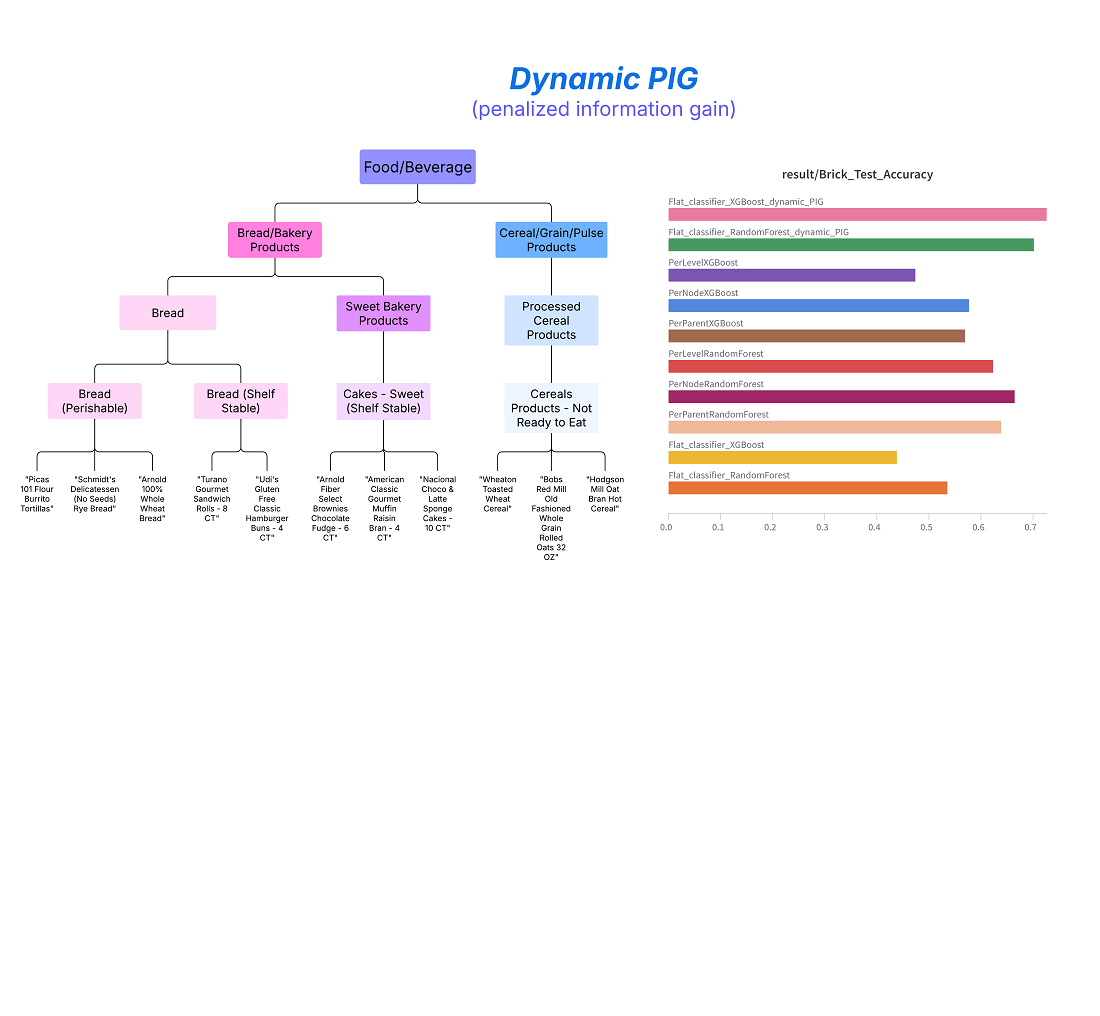
The object of this study is the process of constructing hierarchical classifiers for textual data within a defined taxonomy. The task addressed focuses on minimizing cascading errors and enhancing classification consistency across all hierarchy levels, a critical challenge for deep and imbalanced hierarchical structures. The proposed model leverages the Penalized Information Gain (PIG) criterion with dynamically adjusted weight coefficients.
A model for hierarchical text classification has been built. It aims to improve classification accuracy and preserve the structural logic of data within multi-level taxonomies.
Data featuring a multi-level taxonomy that meets classification requirements have been synthesized and are employed for training and testing classifiers. The performance of local and global hierarchical classification models was compared against conventional classifiers that do not account for taxonomic relationships between classes. The results demonstrate that using weight coefficients based on hierarchical levels enables an adequate representation of taxonomic dependences, which is crucial for maintaining data integrity and improving categorization quality at various levels. Experimental findings show an 8 % increase in the F1 score at the class and subclass levels.
A distinctive feature of the model built is the integration of dynamic weights into the splitting criterion, which allows hierarchical dependences between classes to be effectively addressed and cascading errors, typical of conventional approaches, to be minimized.
The model’s practical application spans product management systems in e-commerce, text analytics in the restaurant business, and automated categorization systems for multi-level structures
Downloads
Published
How to Cite
Issue
Section
License
Copyright (c) 2025 Olga Narushynska, Maksym Arzubov, Vasyl Teslyuk

This work is licensed under a Creative Commons Attribution 4.0 International License.
The consolidation and conditions for the transfer of copyright (identification of authorship) is carried out in the License Agreement. In particular, the authors reserve the right to the authorship of their manuscript and transfer the first publication of this work to the journal under the terms of the Creative Commons CC BY license. At the same time, they have the right to conclude on their own additional agreements concerning the non-exclusive distribution of the work in the form in which it was published by this journal, but provided that the link to the first publication of the article in this journal is preserved.
A license agreement is a document in which the author warrants that he/she owns all copyright for the work (manuscript, article, etc.).
The authors, signing the License Agreement with TECHNOLOGY CENTER PC, have all rights to the further use of their work, provided that they link to our edition in which the work was published.
According to the terms of the License Agreement, the Publisher TECHNOLOGY CENTER PC does not take away your copyrights and receives permission from the authors to use and dissemination of the publication through the world's scientific resources (own electronic resources, scientometric databases, repositories, libraries, etc.).
In the absence of a signed License Agreement or in the absence of this agreement of identifiers allowing to identify the identity of the author, the editors have no right to work with the manuscript.
It is important to remember that there is another type of agreement between authors and publishers – when copyright is transferred from the authors to the publisher. In this case, the authors lose ownership of their work and may not use it in any way.







