Оцінка комбінованого методу тепловідводу та затискання для зменшення деформації зварного шва в низьковуглецевій сталі з використанням газового дугового зварювання металом
DOI:
https://doi.org/10.15587/1729-4061.2025.328730Ключові слова:
теплопровідники, голчастий ферит, деформація, характеристики матеріалу, зварювання металу в середовищі інертного газуАнотація
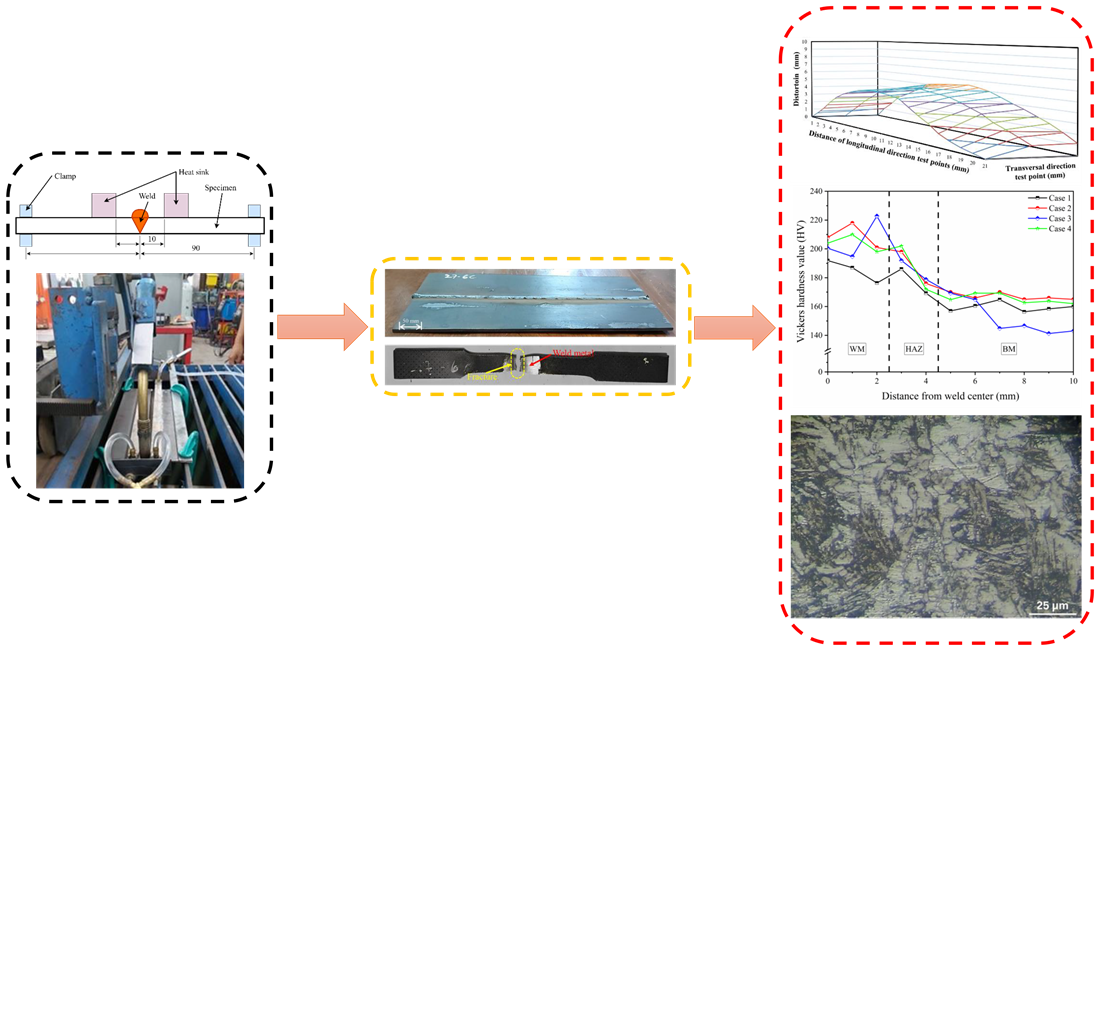
У цій роботі досліджується механічна міцність та управління деформацією з'єднань низьковуглецевої сталі (A36), зварених методом газового дугового зварювання металом (ГДЗМ). ГДЗМ – це поєднання процедур тепловідведення та затискання. Розмірна точність та структурна надійність знижуються через значну деформацію, що виникає під час зварювання. Щоб вирішити цю проблему, у цьому дослідженні розглядається термомеханічна стратегія, яка використовує радіатори та механічні затискачі одночасно під час зварювання. Необроблені з'єднання (після зварювання) та три різні варіанти обробки (HS5-4C, HS27-4C та HS27-6C) були випробувані в різних експериментальних конфігураціях. Використовуючи радіатор з водяним охолодженням при температурі 27°C та шість сталевих затискачів, обробка HS27-6C значно зменшила поздовжню деформацію з 6,7 мм (після зварювання) до 0,85 мм, що становить вражаюче зменшення на 87%. Механічні випробування показали, що у всіх конфігураціях міцність на розтяг становила приблизно 500 МПа, а цілісність зварного шва була збережена, оскільки руйнування були в основному металі, а не в металі шва. Мікроструктурне дослідження виявило збільшення вмісту голчастого фериту (ГФ) у зварному металі оброблених зразків, зокрема HS27-6C, що підвищило в'язкість, а випробування на мікротвердість підтвердили стабільні значення твердості (наприклад, метал шва (МШ): ~200 HV, зона термічного впливу (ЗТВ): ~170 HV, основний метал (ОМ): ~150 HV). Механічне обмеження у вигляді затискачів зменшує нерівномірне розширення та стиснення під час затвердіння, а термічне управління, що досягається шляхом розсіювання надлишкового тепла, відповідає за ефективність методу. Цей комплексний підхід пропонує реалістичний та економічно ефективний спосіб зменшення деформації без шкоди для механічних характеристик. Це особливо важливо в будівельній, автомобільній та виробничій галузях, де важливий точний контроль розмірів
Посилання
- Hajili, S. (2018). Welding processes for joining dissimilar metals and plastics. School of Industrial and Information Engineering, 1, 12–14.
- Ragavendran, M., Vasudevan, M., Hussain, N. (2022). Study of the Microstructure, Mechanical Properties, Residual Stresses, and Distortion in Type 316LN Stainless Steel Medium Thickness Plate Weld Joints. Journal of Materials Engineering and Performance, 31 (6), 5013–5025. https://doi.org/10.1007/s11665-021-06534-1
- Masubuchi, K. (1980). Analysis of welded structures: residual stresses, distortion, and their consequences. Elsevier. https://doi.org/10.1016/c2013-0-05818-5
- Oliveira, J. P., Santos, T. G., Miranda, R. M. (2020). Revisiting fundamental welding concepts to improve additive manufacturing: From theory to practice. Progress in Materials Science, 107, 100590. https://doi.org/10.1016/j.pmatsci.2019.100590
- Gray, T., Camilleri, D., McPherson, N. (2014). Control of welding distortion in thin-plate fabrication: design support exploiting computational simulation. Elsevier.
- Tabatabaeian, A., Ghasemi, A. R., Shokrieh, M. M., Marzbanrad, B., Baraheni, M., Fotouhi, M. (2021). Residual Stress in Engineering Materials: A Review. Advanced Engineering Materials, 24 (3). https://doi.org/10.1002/adem.202100786
- Li, Y., Zhao, Y., Li, Q., Wu, A., Zhu, R., Wang, G. (2017). Effects of welding condition on weld shape and distortion in electron beam welded Ti2AlNb alloy joints. Materials & Design, 114, 226–233. https://doi.org/10.1016/j.matdes.2016.11.083
- Singh, R. (2016). Applied welding engineering: processes, codes, and standards. Butterworth-Heinemann. https://doi.org/10.1016/c2015-0-00784-5
- Andritsos, F., Perez-Prat, J. (2000). State-of-the-art report on The Automation and Integration of Production Processes in Shipbuilding. European Commission, Joint Research Centre, ISIS. https://www.researchgate.net/publication/236095099
- Panji, M., Baskoro, A. S., Widyianto, A. (2019). Effect of Welding Current and Welding Speed on Weld Geometry and Distortion in TIG Welding of A36 Mild Steel Pipe with V-Groove Joint. IOP Conference Series: Materials Science and Engineering, 694 (1), 012026. https://doi.org/10.1088/1757-899x/694/1/012026
- Chen, B.-Q., Liu, K., Xu, S. (2024). Recent Advances in Aluminum Welding for Marine Structures. Journal of Marine Science and Engineering, 12 (9), 1539. https://doi.org/10.3390/jmse12091539
- Radaj, D. (1992). Heat effects of welding: temperature field, residual stress, distortion. Springer Science & Business Media, 348. https://doi.org/10.1007/978-3-642-48640-1
- Mohan, A., Franciosa, P., Dai, D., Ceglarek, D. (2024). A novel approach to control thermal induced buckling during laser welding of battery housing through a unilateral N-2-1 fixturing principle. Journal of Advanced Joining Processes, 10, 100256. https://doi.org/10.1016/j.jajp.2024.100256
- Ilman, M. N., Sehono, Muslih, M. R. (2022). Application of Hybrid Transient Thermal Tensioning/Trailing Active Cooling Treatment for Minimizing Distortion, Residual Stress, and Fatigue Crack Growth Rate of Friction Stir Welding Joints. Journal of Materials Engineering and Performance, 31 (9), 7772–7784. https://doi.org/10.1007/s11665-022-06788-3
- Liu, Z., Jin, X., Zhang, J., Hao, Z., Li, J., Chen, H. (2022). Numerical and experimental investigation on the mechanism of synchronous trailing cold air heat sink in eliminating the deformation during laser welding SUS301L thin sheet. Optics & Laser Technology, 153, 108258. https://doi.org/10.1016/j.optlastec.2022.108258
- Wibowo, H., Karyono, S., Prasetya, T. A., Nugroho, B. (2020). Non-destructive test inspection of gas metal arc welding products with clamp and heat sink treatment on low carbon steel. Journal of Physics: Conference Series, 1700 (1), 012003. https://doi.org/10.1088/1742-6596/1700/1/012003
- Δαούτης, Γ. Ν. (2023). Methods to control distortions of welded structures.
- Go, B.-S., Oh, K.-H., Kwon, S.-I., Bang, H.-S. (2022). Reduction Characteristics of Welding Deformation According to Cooling Distance in Heat Sink Welding. International Journal of Precision Engineering and Manufacturing, 23 (11), 1229–1236. https://doi.org/10.1007/s12541-022-00673-8
- Zhang, C., Li, S., Sun, J., Wang, Y., Deng, D. (2019). Controlling angular distortion in high strength low alloy steel thick-plate T-joints. Journal of Materials Processing Technology, 267, 257–267. https://doi.org/10.1016/j.jmatprotec.2018.12.023
- Gómora, C. M., Ambriz, R. R., Zuno-Silva, J., Jaramillo, D. (2020). Heat Sink Effect on 6061 Aluminum Alloy Welds with Different Partial Aging Conditions. Journal of Materials Engineering and Performance, 29 (7), 4339–4350. https://doi.org/10.1007/s11665-020-04982-9
- Jiang, K., Wang, C., Ren, J., Li, Z., Ma, T. (2025). Nondestructive inspection method of welding rate for heat sink fins with complex structure via infrared thermography principle and deep learning method. Expert Systems with Applications, 260, 125402. https://doi.org/10.1016/j.eswa.2024.125402
- Ramasamy, N., Jeyasimman, D., Kathiravan, R., Raju, N. (2019). Influence of Welding Sequence on Residual Stresses Induced in As-Welded Plug Weld of Low-Carbon Steel Plate. Transactions of the Indian Institute of Metals, 72 (5), 1361–1369. https://doi.org/10.1007/s12666-019-01631-1
- Yi, B., Fu, L., Xue, D., Liu, Y., Lei, W., Wang, J. (2024). Rapid analysis method for process parameter determination of transient thermal tensioning during welding buckling distortion mitigation. Thin-Walled Structures, 202, 112053. https://doi.org/10.1016/j.tws.2024.112053
- Zhao, H., Zhang, Q., Niu, Y., Du, S., Lu, J., Zhang, H., Wang, J. (2020). Influence of triangle reinforcement plate stiffeners on welding distortion mitigation of fillet welded structure for lightweight fabrication. Ocean Engineering, 213, 107650. https://doi.org/10.1016/j.oceaneng.2020.107650
- Sun, Y., Smith, M., Dutilleul, T., Jones, S. (2022). Assessing and mitigating the distortion and stress during electron beam welding of a large shell-flange structure. International Journal of Pressure Vessels and Piping, 199, 104772. https://doi.org/10.1016/j.ijpvp.2022.104772
- Barrios, A. M., Burgos, L. M., Niebles-Nuñez, E. E., Espitia, L. A., Unfried-Silgado, J. (2021). Influence of immersion corrosion on mechanical properties of AISI 430/AISI 316L dissimilar welded joints. International Journal of Engineering, 34 (5), 1352–1361. https://doi.org/10.5829/ije.2021.34.05b.31
- Widyianto, A., Baskoro, A. S., Kiswanto, G., Ganeswara, M. F. G. (2021). Effect of welding sequence and welding current on distortion, mechanical properties and metallurgical observations of orbital pipe welding on SS 316L. Eastern-European Journal of Enterprise Technologies, 2 (12 (110)), 22–31. https://doi.org/10.15587/1729-4061.2021.228161
- Wibowo, H., Surahmanto, F., Ilman, M. N. (2023). Identifying the influence of transient thermal tensioning treatments on minimizing distortion and improving fatigue behavior of steel welded. Eastern-European Journal of Enterprise Technologies, 4 (12 (124)), 37–46. https://doi.org/10.15587/1729-4061.2023.285192
- Holder, R., Larkin, N., Li, H., Kuzmikova, L., Pan, Z., Norrish, J. (2011). Development of a DC-LSND welding process for GMAW on DH-36 Steel. 56th WTIA annual conference 2011.
- Babu, P. D., Gouthaman, P., Marimuthu, P. (2019). Effect of Heat Sink and Cooling Mediums on Ferrite Austenite Ratio and Distortion in Laser Welding of Duplex Stainless Steel 2205. Chinese Journal of Mechanical Engineering, 32 (1). https://doi.org/10.1186/s10033-019-0363-5
- Babasafari, Z., Pan, A. V., Pahlevani, F., Hossain, R., Sahajwalla, V., du Toit, M., Dippenaar, R. (2020). Effects of austenizing temperature, cooling rate and isothermal temperature on overall phase transformation characteristics in high carbon steel. Journal of Materials Research and Technology, 9 (6), 15286–15297. https://doi.org/10.1016/j.jmrt.2020.10.071
- Long, S., Liang, Y., Jiang, Y., Liang, Y., Yang, M., Yi, Y. (2016). Effect of quenching temperature on martensite multi-level microstructures and properties of strength and toughness in 20CrNi2Mo steel. Materials Science and Engineering: A, 676, 38–47. https://doi.org/10.1016/j.msea.2016.08.065
- Lakshminarayanan, A. K., Balasubramanian, V. (2010). Tensile and Impact Toughness Properties of Gas Tungsten Arc Welded and Friction Stir Welded Interstitial Free Steel Joints. Journal of Materials Engineering and Performance, 20 (1), 82–89. https://doi.org/10.1007/s11665-010-9649-6
- Zhou, Q., Wang, Y., Choi, S.-K., Cao, L., Gao, Z. (2018). Robust optimization for reducing welding-induced angular distortion in fiber laser keyhole welding under process parameter uncertainty. Applied Thermal Engineering, 129, 893–906. https://doi.org/10.1016/j.applthermaleng.2017.10.081
- Jorge, L. de J., Cândido, V. S., Silva, A. C. R. da, Garcia Filho, F. da C., Pereira, A. C., Luz, F. S. da, Monteiro, S. N. (2018). Mechanical properties and microstructure of SMAW welded and thermically treated HSLA-80 steel. Journal of Materials Research and Technology, 7 (4), 598–605. https://doi.org/10.1016/j.jmrt.2018.08.007
- Abioye, T. E., Omotehinse, I. S., Oladele, I. O., Olugbade, T. O., Ogedengbe, T. I. (2020). Effects of post-weld heat treatments on the microstructure, mechanical and corrosion properties of gas metal arc welded 304 stainless steel. World Journal of Engineering, 17 (1), 87–96. https://doi.org/10.1108/wje-11-2019-0323
- Rizvi, S. A. (2020). Effect of Heat Input on Microstructural and Mechanical Properties of AISI 304 Welded Joint Via MIG Welding. International Journal of Engineering, 33 (9), 1811–1816. https://doi.org/10.5829/ije.2020.33.09c.16
##submission.downloads##
Опубліковано
Як цитувати
Номер
Розділ
Ліцензія
Авторське право (c) 2025 Heri Wibowo, Slamet Karyono, Tri Adi Prasetya, Ahmad Fikrie, Agus Widyianto

Ця робота ліцензується відповідно до Creative Commons Attribution 4.0 International License.
Закріплення та умови передачі авторських прав (ідентифікація авторства) здійснюється у Ліцензійному договорі. Зокрема, автори залишають за собою право на авторство свого рукопису та передають журналу право першої публікації цієї роботи на умовах ліцензії Creative Commons CC BY. При цьому вони мають право укладати самостійно додаткові угоди, що стосуються неексклюзивного поширення роботи у тому вигляді, в якому вона була опублікована цим журналом, але за умови збереження посилання на першу публікацію статті в цьому журналі.
Ліцензійний договір – це документ, в якому автор гарантує, що володіє усіма авторськими правами на твір (рукопис, статтю, тощо).
Автори, підписуючи Ліцензійний договір з ПП «ТЕХНОЛОГІЧНИЙ ЦЕНТР», мають усі права на подальше використання свого твору за умови посилання на наше видання, в якому твір опублікований. Відповідно до умов Ліцензійного договору, Видавець ПП «ТЕХНОЛОГІЧНИЙ ЦЕНТР» не забирає ваші авторські права та отримує від авторів дозвіл на використання та розповсюдження публікації через світові наукові ресурси (власні електронні ресурси, наукометричні бази даних, репозитарії, бібліотеки тощо).
За відсутності підписаного Ліцензійного договору або за відсутністю вказаних в цьому договорі ідентифікаторів, що дають змогу ідентифікувати особу автора, редакція не має права працювати з рукописом.
Важливо пам’ятати, що існує і інший тип угоди між авторами та видавцями – коли авторські права передаються від авторів до видавця. В такому разі автори втрачають права власності на свій твір та не можуть його використовувати в будь-який спосіб.