Визначення ефективності застосування кінцевих автоматів у шифруванні та дешифруванні
DOI:
https://doi.org/10.15587/1729-4061.2025.331044Ключові слова:
скінченні автомати, автомати мілі, криптографія з кінцевими автоматами, композиція автоматів, статистичний криптоаналізАнотація
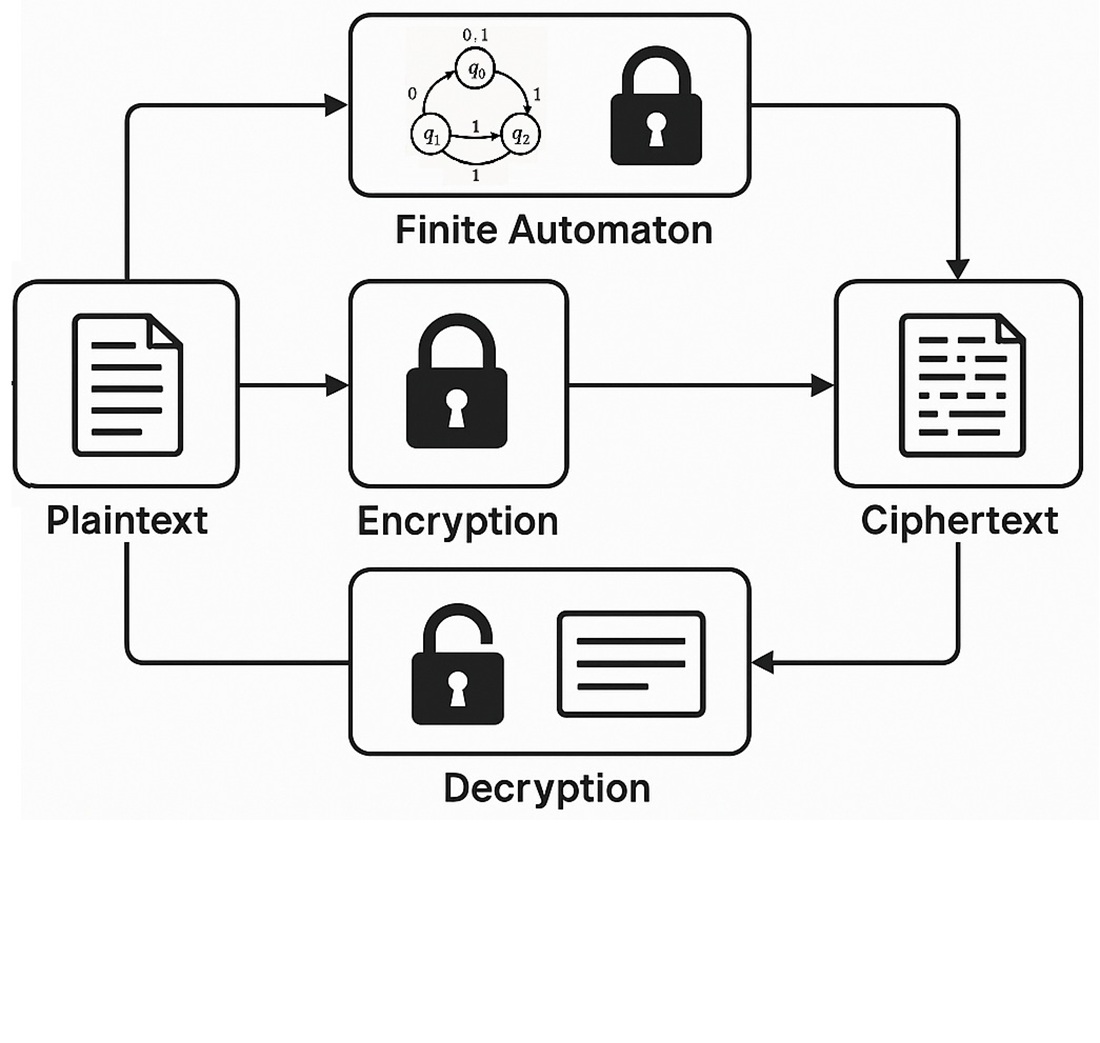
Сучасна криптографічна галузь відзначена зусиллями вдосконалити традиційні методи шляхом інтеграції нових математичних концепцій. Це спрямоване на усунення недоліків класичної криптографії, вирішення нових проблем безпеки та розробку більш складних систем захисту даних. Серед цих інновацій – застосування кінцевих автоматів, або CryptoAutomata, які використовуються як кодери та декодери. Об'єктом цього дослідження є використання скінченних автоматів, зокрема криптоавтоматів, у криптографічних системах. Дослідження розглядає проблему вразливостей у класичних криптографічних методах, які включають схильність до нових криптоаналітичних атак та неефективність обчислювальних витрат.
Суть отриманих результатів полягає в демонстрації практичної реалізації та криптографічних переваг оборотних скінченних автоматів, включаючи сюр'єктивні автомати та автомати Мілі, інтегровані в системи шифрування. Завдяки властивим цим автоматам властивостям, таким як оборотність, компонуємість та обчислювальна ефективність, вдалося підвищити безпеку шифрування, значно ускладнивши спроби криптоаналізу. Ці результати пояснюються, перш за все, композиційним підходом, який передбачає об'єднання кількох скінченних автоматів для формування складних структур шифрування. Були проведені ретельні статистичні оцінки, включаючи NPCR та UACI, які дали значення NPCR у діапазоні від 99,56% до 99,61% та значення UACI близько 33%, що підтверджує сильну стійкість до диференціальних атак. Крім того, стійкість до шуму була підтверджена за допомогою оцінок PSNR, досягнувши значень понад 35 дБ навіть за умов значного шуму, що підтверджує надійність у практичних сценаріях. Крім того, криптографічну стійкість було підтверджено статистичними тестами випадковості NIST
Посилання
- Al Busafi, S., Kumar, B. (2020). Review and Analysis of Cryptography Techniques. 2020 9th International Conference System Modeling and Advancement in Research Trends (SMART), 323–327. https://doi.org/10.1109/smart50582.2020.9336792
- Salami, Y., Khajevand, V., Zeinali, E. (2023). Cryptographic algorithms: a review of the literature, weaknesses and open challenges. Journal of Computer & Robotics, 16 (2). https://doi.org/10.22094/JCR.2023.1983496.1298
- Sharipbay, A., Saukhanova, Z., Shakhmetova, G., Barlybayev, A. (2023). Development of Reliable and Effective Methods of Cryptographic Protection of Information Based on the Finite Automata Theory. The Eurasia Proceedings of Science Technology Engineering and Mathematics, 26, 19–25. https://doi.org/10.55549/epstem.1409285
- Kohavi, Z., Jha, N. K. (2009). Switching and Finite Automata Theory. Cambridge University Press. https://doi.org/10.1017/cbo9780511816239
- Lotfi, Z., Khalifi, H., Ouardi, F. (2023). Efficient Algebraic Method for Testing the Invertibility of Finite State Machines. Computation, 11 (7), 125. https://doi.org/10.3390/computation11070125
- Tao, R., Chen, Sh. (1985). A finite automaton public key cryptosystem and digital signatures. Chinese Journal of Computers, 8 (6), 401–409.
- Abubaker, S., Wu, K. (2013). DAFA - A Lightweight DES Augmented Finite Automaton Cryptosystem. Security and Privacy in Communication Networks, 1–18. https://doi.org/10.1007/978-3-642-36883-7_1
- Kodada, B. (2022). FSAaCIT: Finite State Automata based One-Key Cryptosystem and Chunk-based Indexing Technique for Secure Data De-duplication in Cloud Computing. https://doi.org/10.36227/techrxiv.20443653.v1
- Salas Pena, P. I., Ernesto Gonzalez Torres, R. (2016). Authenticated Encryption based on finite automata cryptosystems. 2016 13th International Conference on Electrical Engineering, Computing Science and Automatic Control (CCE), 1–6. https://doi.org/10.1109/iceee.2016.7751254
- Gysin, M. (1996). A one-key cryptosystem based on a finite nonlinear automaton. Cryptography: Policy and Algorithms, 165–173. https://doi.org/10.1007/bfb0032356
- Lakshmi, S. (2012). On finite state machines and recursive functions – applications to cryptosystems. Jawaharlal Nehru Technological University.
- Meskanen, T. (2001). On finite automaton public key cryptosystems. TUCS Technical Report.
- Tao, R., Chen, S., Chen, X. (1997). FAPKC3: A new finite automaton public key cryptosystem. Journal of Computer Science and Technology, 12 (4), 289–305. https://doi.org/10.1007/bf02943149
- Tao, R., Chen, S. (1999). The generalization of public key cryptosystem FAPKC4. Chinese Science Bulletin, 44 (9), 784–790. https://doi.org/10.1007/bf02885019
- Kodada, B. B., D’Mello, D. A. (2021). Symmetric Key Cryptosystem based on Sequential State Machine. IOP Conference Series: Materials Science and Engineering, 1187 (1), 012026. https://doi.org/10.1088/1757-899x/1187/1/012026
- Shakhmetova, G., Barlybayev, A., Saukhanova, Z., Sharipbay, A., Raykul, S., Khassenov, A. (2024). Enhancing Visual Data Security: A Novel FSM-Based Image Encryption and Decryption Methodology. Applied Sciences, 14 (11), 4341. https://doi.org/10.3390/app14114341
- Zhang, M., Dong, S., Kong, H., Liu, X., Guan, H. (2016). Modeling and Simulation Strategies of Cryptographic Protocols Based on Finite State Machine. Information Technology and Intelligent Transportation Systems, 541–551. https://doi.org/10.1007/978-3-319-38789-5_62
- Attari, S., Shahmirzadi, A. R., Salmasizadeh, M., Gholampour, I. (2017). Finite State Machine Based Countermeasure for Cryptographic Algorithms. 2017 14th International ISC (Iranian Society of Cryptology) Conference on Information Security and Cryptology (ISCISC), 58–63. https://doi.org/10.1109/iscisc.2017.8488336
- Papanastasiou, P., Ottaviani, C., Pirandola, S. (2017). Finite-size analysis of measurement-device-independent quantum cryptography with continuous variables. Physical Review A, 96 (4). https://doi.org/10.1103/physreva.96.042332
- de la Cruz Jiménez, R. A. (2019). Generation of 8-Bit S-Boxes Having Almost Optimal Cryptographic Properties Using Smaller 4-Bit S-Boxes and Finite Field Multiplication. Progress in Cryptology – LATINCRYPT 2017, 191–206. https://doi.org/10.1007/978-3-030-25283-0_11
- Waseem, H. M., Khan, M. (2018). Information Confidentiality Using Quantum Spinning, Rotation and Finite State Machine. International Journal of Theoretical Physics, 57 (11), 3584–3594. https://doi.org/10.1007/s10773-018-3872-6
- Agrawal, S., Ishai, Y., Kushilevitz, E., Narayanan, V., Prabhakaran, M., Prabhakaran, V., Rosen, A. (2020). Cryptography from One-Way Communication: On Completeness of Finite Channels. Advances in Cryptology – ASIACRYPT 2020, 653–685. https://doi.org/10.1007/978-3-030-64840-4_22
- Cintas-Canto, A., Kermani, M. M., Azarderakhsh, R. (2023). Reliable Architectures for Finite Field Multipliers Using Cyclic Codes on FPGA Utilized in Classic and Post-Quantum Cryptography. IEEE Transactions on Very Large Scale Integration (VLSI) Systems, 31 (1), 157–161. https://doi.org/10.1109/tvlsi.2022.3224357
- Roy, A., Steiner, M. J. (2025). Generalized Triangular Dynamical System: An Algebraic System for Constructing Cryptographic Permutations over Finite Fields. Selected Areas in Cryptography – SAC 2024, 139–165. https://doi.org/10.1007/978-3-031-82841-6_6
- Lavanya, M., Sundar, K., Saravanan, S. (2025). Finite Field-Based Three-Tier Cryptography Algorithm to Secure the Images. Defence Science Journal, 75 (1).
- Sharipbay, A. (2016). Automata models in cryptography. KazNU Bulletin. Mathematics, Mechanics, Computer Science Series, 3 (1 (90)), 94–104.
- Bogachenko, N. (2007). Application of automata-theoretic models in cryptography. Mathematical Structures and Modeling, 1 (17), 112–120.
- Olson, R. (1970). On the invertibility of finite state machines. No. TR-EE-703.
- Tao, R. (2009). Finite Automata and Application to Cryptography. Springer Berlin Heidelberg. https://doi.org/10.1007/978-3-540-78257-5
- Shakhmetova, G., Saukhanova, Z., Udzir, N. I., Sharipbay, A., Saukhanov, N. (2021). Application of Pseudo-Memory Finite Automata for Information Encryption. Proceedings of the 2nd International Workshop on Intelligent Information Technologies & Systems of Information Security with CEUR-WS.
- Noura, H. N., Chehab, A., Couturier, R. (2020). Overview of Efficient Symmetric Cryptography: Dynamic vs Static Approaches. 2020 8th International Symposium on Digital Forensics and Security (ISDFS), 1–6. https://doi.org/10.1109/isdfs49300.2020.9116441
- Shakhmetova, G., Saukhanova, Z., Sharipbay, A., Ulyukova G. (2020). Using Reversible Finite-State Machines In Asymmetrical Cryptosystems. Journal of Almaty University Of Power Engineering And Communications, 1, 118.
- Abed, Q. K., Al-Jawher, W. A. M. (2024). Enhanced Hyperchaotic Image Encryption with CAW Transform and Sea-Lion Optimizer. Journal of Cyber Security and Mobility, 13 (5), 1207–1238. https://doi.org/10.13052/jcsm2245-1439.13517
- Setiadi, D. R. I. M., Rijati, N. (2023). An Image Encryption Scheme Combining 2D Cascaded Logistic Map and Permutation-Substitution Operations. Computation, 11 (9), 178. https://doi.org/10.3390/computation11090178
- Abusham, E., Ibrahim, B., Zia, K., Rehman, M. (2023). Facial Image Encryption for Secure Face Recognition System. Electronics, 12 (3), 774. https://doi.org/10.3390/electronics12030774
- Khan, S., Peng, H. (2024). A secure and adaptive block-based image encryption: a novel high-speed approach. Nonlinear Dynamics, 112 (18), 16445–16473. https://doi.org/10.1007/s11071-024-09870-8
- Pareschi, F., Rovatti, R., Setti, G. (2012). On Statistical Tests for Randomness Included in the NIST SP800-22 Test Suite and Based on the Binomial Distribution. IEEE Transactions on Information Forensics and Security, 7 (2), 491–505. https://doi.org/10.1109/tifs.2012.2185227
##submission.downloads##
Опубліковано
Як цитувати
Номер
Розділ
Ліцензія
Авторське право (c) 2025 Zhanat Saukhanova, Altynbek Sharipbay, Gulmira Shakhmetova, Alibek Barlybayev, Sayat Raykul, Altay Khassenov

Ця робота ліцензується відповідно до Creative Commons Attribution 4.0 International License.
Закріплення та умови передачі авторських прав (ідентифікація авторства) здійснюється у Ліцензійному договорі. Зокрема, автори залишають за собою право на авторство свого рукопису та передають журналу право першої публікації цієї роботи на умовах ліцензії Creative Commons CC BY. При цьому вони мають право укладати самостійно додаткові угоди, що стосуються неексклюзивного поширення роботи у тому вигляді, в якому вона була опублікована цим журналом, але за умови збереження посилання на першу публікацію статті в цьому журналі.
Ліцензійний договір – це документ, в якому автор гарантує, що володіє усіма авторськими правами на твір (рукопис, статтю, тощо).
Автори, підписуючи Ліцензійний договір з ПП «ТЕХНОЛОГІЧНИЙ ЦЕНТР», мають усі права на подальше використання свого твору за умови посилання на наше видання, в якому твір опублікований. Відповідно до умов Ліцензійного договору, Видавець ПП «ТЕХНОЛОГІЧНИЙ ЦЕНТР» не забирає ваші авторські права та отримує від авторів дозвіл на використання та розповсюдження публікації через світові наукові ресурси (власні електронні ресурси, наукометричні бази даних, репозитарії, бібліотеки тощо).
За відсутності підписаного Ліцензійного договору або за відсутністю вказаних в цьому договорі ідентифікаторів, що дають змогу ідентифікувати особу автора, редакція не має права працювати з рукописом.
Важливо пам’ятати, що існує і інший тип угоди між авторами та видавцями – коли авторські права передаються від авторів до видавця. В такому разі автори втрачають права власності на свій твір та не можуть його використовувати в будь-який спосіб.