Автоматизована діагностика електрокардіограм у режимі реального часу на основі модифікованого алгоритму Пана-Томпкінса для систем тривалого моніторингу
DOI:
https://doi.org/10.15587/1729-4061.2025.336172Ключові слова:
електрокардіограма, холтерівське моніторування, автоматизований аналіз, алгоритм Пана-Томпкінса, ESP32, QRS-комплексАнотація
Об’єктом дослідження є процес автоматизованого аналізу електрокардіосигналу (ЕКС) під час тривалого моніторингу в режимі реального часу, що здійснюється мобільними бездротовими системами. У дослідженні розв’язується проблема недостатньої точності автоматизованої діагностики при тривалому моніторингу електрокардіограми (ЕКГ) в умовах обмежених обчислювальних ресурсів та наявності шумів.
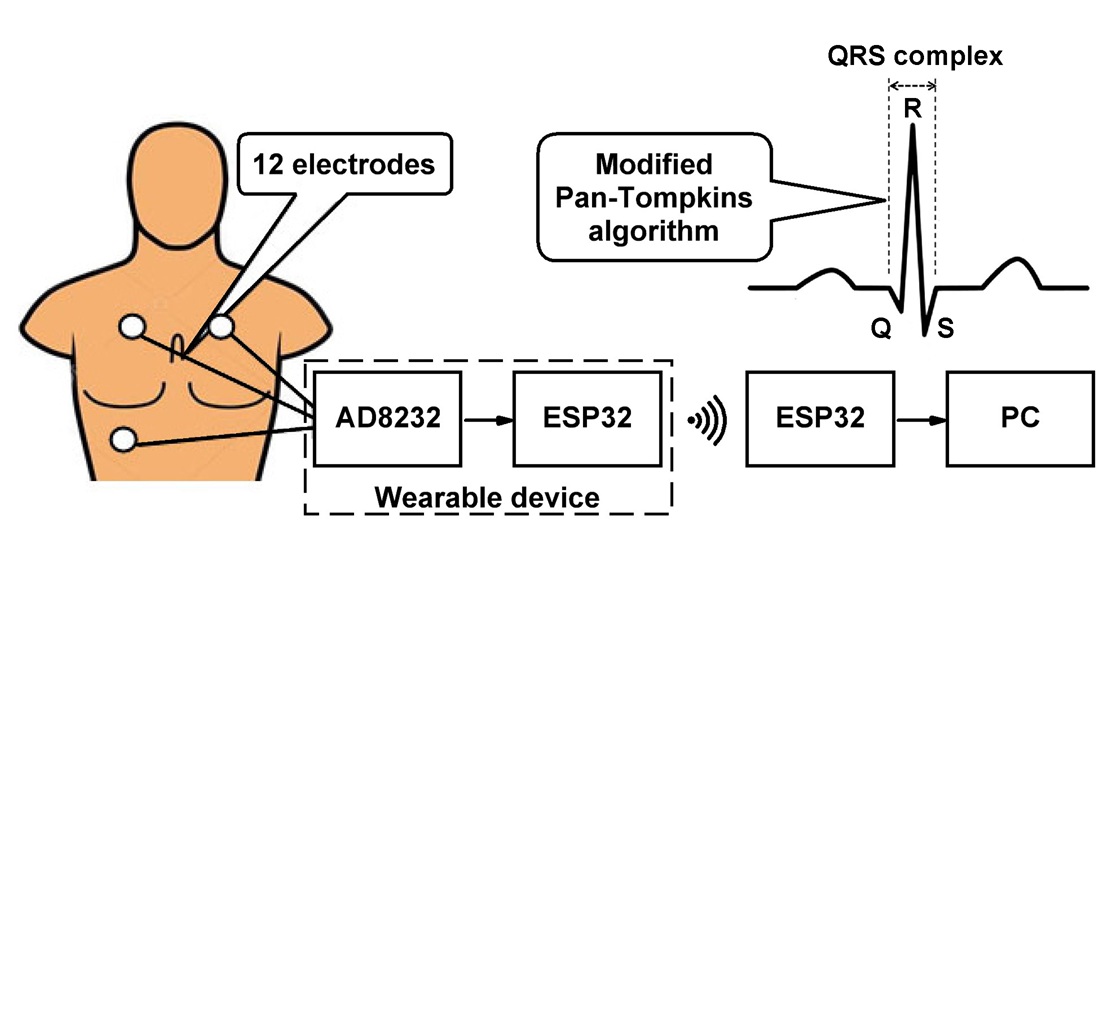
Розроблено модифікований алгоритм Пана-Томпкінса для визначення меж QRS-комплексу. На основі цього алгоритму реалізовано програмний модуль PCard для апаратно-програмного комплексу, що забезпечує якісну автоматизовану діагностику як у стандартному режимі, так і під час тривалого моніторингу ЕКГ у 12-ти відведеннях у режимі реального часу.
Програмний модуль PCard дозволяє здійснювати реєстрацію ЕКС, цифрову фільтрацію, вимірювання й розрахунок електрокардіографічних параметрів, автоматичне визначення діагностичних критеріїв і висновків, формування загального діагностичного висновку ЕКГ, а також лікарську обробку ЕКГ.
Високу якість діагностичного аналізу підтверджують отримані показники точності алгоритму: для визначення нормальних комплексів – 99,99%, для визначення шлуночкових комплексів – 99,90%, для виявлення різних патологій – 98,43%. Час обробки ЕКГ становив близько 4,7 секунди для запису тривалістю 40 хвилин.
Запропонована методика визначення меж комплексів QRS ґрунтується на використанні методу скінченних різниць, що вигідно відрізняє її від поширених методик зі спектральним аналізом, методом вейвлет-перетворень чи перетворення Фур’є. Такий підхід спрощує визначення параметрів основних елементів ЕКГ і суттєво скорочує обсяг обчислень, що в цілому підвищує швидкість обробки та зменшує потребу в системних ресурсах
Посилання
- Global Effect of Modifiable Risk Factors on Cardiovascular Disease and Mortality (2023). New England Journal of Medicine, 389 (14), 1273–1285. https://doi.org/10.1056/nejmoa2206916
- Setiawidayat, S. (2023). Discrete electrocardiogram T amplitude detection based on cycle duration. Eastern-European Journal of Enterprise Technologies, 3 (9 (123)), 94–105. https://doi.org/10.15587/1729-4061.2023.282759
- Liu, F., Liu, C., Jiang, X., Zhang, Z., Zhang, Y., Li, J., Wei, S. (2018). Performance Analysis of Ten Common QRS Detectors on Different ECG Application Cases. Journal of Healthcare Engineering, 2018, 1–8. https://doi.org/10.1155/2018/9050812
- Attia, Z. I., Noseworthy, P. A., Lopez-Jimenez, F., Asirvatham, S. J., Deshmukh, A. J., Gersh, B. J. et al. (2019). An artificial intelligence-enabled ECG algorithm for the identification of patients with atrial fibrillation during sinus rhythm: a retrospective analysis of outcome prediction. The Lancet, 394 (10201), 861–867. https://doi.org/10.1016/s0140-6736(19)31721-0
- Havranek, S., Stekla, B., Vesela, M., Holub, J., Miksova, L., Kvasnickova, K. et al. (2025). Artificial intelligence in resting ecg: higher accuracy in the interpretation of rhythm abnormalities. Europace, 27. https://doi.org/10.1093/europace/euaf085.029
- So-In, C., Phaudphut, C., Rujirakul, K. (2015). Real-Time ECG Noise Reduction with QRS Complex Detection for Mobile Health Services. Arabian Journal for Science and Engineering, 40 (9), 2503–2514. https://doi.org/10.1007/s13369-015-1658-1
- Xiang, Y., Lin, Z., Meng, J. (2018). Automatic QRS complex detection using two-level convolutional neural network. BioMedical Engineering OnLine, 17 (1). https://doi.org/10.1186/s12938-018-0441-4
- He, R., Liu, Y., Wang, K., Zhao, N., Yuan, Y., Li, Q., Zhang, H. (2021). Automatic Detection of QRS Complexes Using Dual Channels Based on U-Net and Bidirectional Long Short-Term Memory. IEEE Journal of Biomedical and Health Informatics, 25 (4), 1052–1061. https://doi.org/10.1109/jbhi.2020.3018563
- QRS Detection Based on Discrete Wavelet Transform for ECG Signal with Motion Artifacts (2024). Journal of Advanced Research in Applied Sciences and Engineering Technology, 40 (1), 118–128. https://doi.org/10.37934/araset.40.1.118128
- Khan, N., Imtiaz, M. N. (2023). Pan-Tompkins++: A Robust Approach to Detect R-peaks in ECG Signals. https://doi.org/10.32920/22734308
- Abd Al-Jabbar, E. Y., Al-Hatab, M. M. M., Qasim, M. A., Fathel, W. R., Fadhil, M. A. (2023). Clinical Fusion for Real-Time Complex QRS Pattern Detection in Wearable ECG Using the Pan-Tompkins Algorithm. Fusion: Practice and Applications, 12 (2), 172–184. https://doi.org/10.54216/fpa.120214
- Fariha, M. A. Z., Ikeura, R., Hayakawa, S., Tsutsumi, S. (2020). Analysis of Pan-Tompkins Algorithm Performance with Noisy ECG Signals. Journal of Physics: Conference Series, 1532 (1), 012022. https://doi.org/10.1088/1742-6596/1532/1/012022
- Félix, R. A., Ochoa-Brust, A., Mata-López, W., Martínez-Peláez, R., Mena, L. J., Valdez-Velázquez, L. L. (2023). Fast Parabolic Fitting: An R-Peak Detection Algorithm for Wearable ECG Devices. Sensors, 23 (21), 8796. https://doi.org/10.3390/s23218796
- Belkadi, M., Daamouche, A. (2020). Swarm Intelligence Approach to QRS Detection. The International Arab Journal of Information Technology, 17 (4), 480–487. https://doi.org/10.34028/iajit/17/4/6
- Zhao, K., Li, Y., Wang, G., Pu, Y., Lian, Y. (2021). A robust QRS detection and accurate R-peak identification algorithm for wearable ECG sensors. Science China Information Sciences, 64 (8). https://doi.org/10.1007/s11432-020-3150-2
- Ribeiro, L., Rosa, M. M. A., Soares, R., Costa, E. (2024). Exploring Approximate Adders for an Energy-Efficient Pre-Processing Pan-Tompkins Algorithm VLSI Design. 2024 37th SBC/SBMicro/IEEE Symposium on Integrated Circuits and Systems Design (SBCCI), 1–5. https://doi.org/10.1109/sbcci62366.2024.10703995
- Waleed, R. (2024). Real-time processing stages of electrocardiogram signal: a review. Journal of Modern Technology and Engineering, 9 (1), 39–54. https://doi.org/10.62476/jmte9139
- Gerasimova, Y., Ivel, V., Moldakhmetov, S., Petrov, P. (2024). Hardware-software implementation of a local Wi-Fi network for the transmission of biomedical signals. Eastern-European Journal of Enterprise Technologies, 4 (9 (130)), 34–43. https://doi.org/10.15587/1729-4061.2024.309387
- Ivel, V. P., Gerasimova, Y. V., Moldakhmetov, S. S., Petrov, P. A., Gerasimov, I. A., Zainchkovskaya, K. V. (2019). Wireless three-channel Holter monitoring system. IOP Conference Series: Materials Science and Engineering, 537 (3), 032090. https://doi.org/10.1088/1757-899x/537/3/032090
- Database ROHMINE. ROHMINE. Available at: http://rohmine.org/baza-dannykh-rokhmine/
- LeVeque, R. J. (2007). Finite difference methods for ordinary and partial differential equations: steady-state and time-dependent problems. Philadelphia: Society for Industrial and Applied Mathematics (SIAM).
- Manikandan, M. S., Soman, K. P. (2012). A novel method for detecting R-peaks in electrocardiogram (ECG) signal. Biomedical Signal Processing and Control, 7 (2), 118–128. https://doi.org/10.1016/j.bspc.2011.03.004
- Hossain, M. B., Bashar, S. K., Walkey, A. J., McManus, D. D., Chon, K. H. (2019). An Accurate QRS Complex and P Wave Detection in ECG Signals Using Complete Ensemble Empirical Mode Decomposition with Adaptive Noise Approach. IEEE Access, 7, 128869–128880. https://doi.org/10.1109/access.2019.2939943
- Arzeno, N. M., Deng, Z.-D., Poon, C.-S. (2008). Analysis of First-Derivative Based QRS Detection Algorithms. IEEE Transactions on Biomedical Engineering, 55 (2), 478–484. https://doi.org/10.1109/tbme.2007.912658
- Benitez, D., Gaydecki, P. A., Zaidi, A., Fitzpatrick, A. P. (2001). The use of the Hilbert transform in ECG signal analysis. Computers in Biology and Medicine, 31 (5), 399–406. https://doi.org/10.1016/s0010-4825(01)00009-9
- Li, Q., Liu, Y., Zhao, N., Yuan, Y., He, R. (2023). A Novel ECG QRS Complex Detection Algorithm Based on Dynamic Bayesian Network. https://doi.org/10.36227/techrxiv.22791089
- Lai, D., Zhang, F., Wang, C. (2015). A real-time QRS complex detection algorithm based on differential threshold method. 2015 IEEE International Conference on Digital Signal Processing (DSP), 129–133. https://doi.org/10.1109/icdsp.2015.7251844
- Neri, L., Oberdier, M. T., Augello, A., Suzuki, M., Tumarkin, E., Jaipalli, S. et al. (2023). Algorithm for Mobile Platform-Based Real-Time QRS Detection. Sensors, 23 (3), 1625. https://doi.org/10.3390/s23031625
- Gradl, S., Kugler, P., Lohmuller, C., Eskofier, B. (2012). Real-time ECG monitoring and arrhythmia detection using Android-based mobile devices. 2012 Annual International Conference of the IEEE Engineering in Medicine and Biology Society, 2452–2455. https://doi.org/10.1109/embc.2012.6346460
##submission.downloads##
Опубліковано
Як цитувати
Номер
Розділ
Ліцензія
Авторське право (c) 2025 Yuliya Gerasimova, Fatimah Sidi, Victor Ivel, Vladimir Avdeyev, Lili Nurliyana Abdullah, Sayat Moldakhmetov

Ця робота ліцензується відповідно до Creative Commons Attribution 4.0 International License.
Закріплення та умови передачі авторських прав (ідентифікація авторства) здійснюється у Ліцензійному договорі. Зокрема, автори залишають за собою право на авторство свого рукопису та передають журналу право першої публікації цієї роботи на умовах ліцензії Creative Commons CC BY. При цьому вони мають право укладати самостійно додаткові угоди, що стосуються неексклюзивного поширення роботи у тому вигляді, в якому вона була опублікована цим журналом, але за умови збереження посилання на першу публікацію статті в цьому журналі.
Ліцензійний договір – це документ, в якому автор гарантує, що володіє усіма авторськими правами на твір (рукопис, статтю, тощо).
Автори, підписуючи Ліцензійний договір з ПП «ТЕХНОЛОГІЧНИЙ ЦЕНТР», мають усі права на подальше використання свого твору за умови посилання на наше видання, в якому твір опублікований. Відповідно до умов Ліцензійного договору, Видавець ПП «ТЕХНОЛОГІЧНИЙ ЦЕНТР» не забирає ваші авторські права та отримує від авторів дозвіл на використання та розповсюдження публікації через світові наукові ресурси (власні електронні ресурси, наукометричні бази даних, репозитарії, бібліотеки тощо).
За відсутності підписаного Ліцензійного договору або за відсутністю вказаних в цьому договорі ідентифікаторів, що дають змогу ідентифікувати особу автора, редакція не має права працювати з рукописом.
Важливо пам’ятати, що існує і інший тип угоди між авторами та видавцями – коли авторські права передаються від авторів до видавця. В такому разі автори втрачають права власності на свій твір та не можуть його використовувати в будь-який спосіб.