Розробка попередньої моделі для вирішення проблеми корозії нафтенової кислоти, спричиненої ASTM A-335 P9, з використанням екоферментного зеленого інгібітора на залишках важкого вакуумного газойлю
DOI:
https://doi.org/10.15587/1729-4061.2025.347916Ключові слова:
інгібітор зеленої корозії, біомаса, екофермент, ізотерма Ленгмюра, адсорбція, нафтопереробний заводАнотація
Стандарт ASTM A-335 P9 широко використовується в трубопровідній інфраструктурі установки дистиляції сирої нафти для транспортування залишків важкого вакуумного газойлю (ЗВВГ) перед подальшою обробкою завдяки своїм високим механічним властивостям.
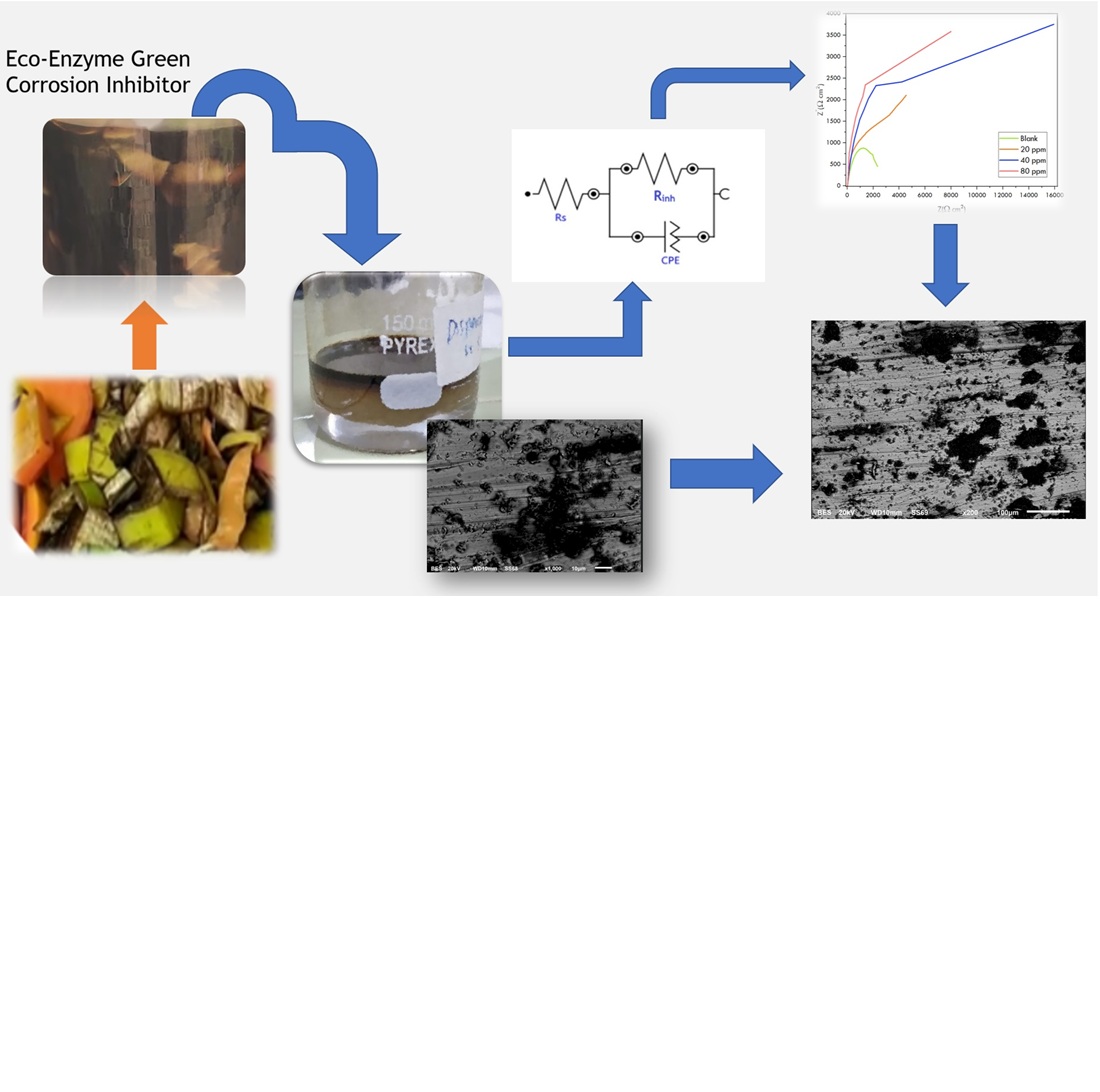
Через підвищені робочі температури та наявність сірки матеріал залишається вразливим до корозії нафтенової кислоти, що може поставити під загрозу його структурну та експлуатаційну цілісність. У цьому дослідженні вивчається реакція матеріалу на застосування екоферменту як інгібітора зеленої корозії з використанням кількох ретельних випробувань під дією дистиляту нафтенової кислоти, зібраного та обробленого з трубопроводу важкого вакуумного газойлю. Оптична емісійна спектроскопія (ОЕС), ультрафіолетово-видима спектроскопія та інфрачервона спектроскопія з перетворенням Фур'є з потенціодинамічною поляризацією та електрохімічною імпедансною спектроскопією досліджують корозійну стійкість інгібітора EE під дією екстрактів нафтенової кислоти. Крім того, для виявлення морфології поверхні та елементної ідентичності механізму збереженого інгібування було використано скануючу електронну мікроскопію та енергетичну рентгенівську дисперсію. На основі ОЕС виявлено присутність Cr та Mo зі складом 9,135% та 0,894%, що відповідає специфікації матеріалу 9Cr-1Mo. Електронний перехід π-π* та n-π* переходів добре узгоджується з наявністю ароматичних -OH, C-H sp3, R-CHO, C=O, C-O та ароматичним поглинанням при 525 нм, що корелює з піками, що спостерігаються в ІЧ-спектрах з перетворенням Фур'є при 3200–3400, 2800–3000 см-1. Висока ефективність інгібування понад 77% корелює з адсорбцією інгібітора, який термодинамічно дотримується ізотерми адсорбції Ленгмюра та застосовний до моделі системи ЗВВГ
Посилання
- Rodríguez-Antón, L. M., Gutiérrez-Martín, F., Martinez-Arevalo, C. (2015). Experimental determination of some physical properties of gasoline, ethanol and ETBE ternary blends. Fuel, 156, 81–86. https://doi.org/10.1016/j.fuel.2015.04.040
- Esouilem, M., Bouzid, A.-H., Nadeau, S. (2022). Pressure Vessels and Piping Accident Analysis and Prevention: A Case Study in Canada. International Journal of Safety and Security Engineering, 12 (1), 105–114. https://doi.org/10.18280/ijsse.120113
- Stepanova, N. E. (2022). Environmental safety and environmental protection at an oil refinery. Advances in Current Natural Sciences, 5, 78–83. https://doi.org/10.17513/use.37828
- Rajaram, K., Jaikumar, R., Behlau, F., van Esch, F., Heynen, C., Kaiser, R. et al. (1999). Robust Process Control at Cerestar’s Refineries. Interfaces, 29 (1), 30–48. https://doi.org/10.1287/inte.29.1.30
- Sukcharoen, K., Leatham, D. J. (2017). Hedging downside risk of oil refineries: A vine copula approach. Energy Economics, 66, 493–507. https://doi.org/10.1016/j.eneco.2017.07.012
- Verma, C., Ebenso, E. E., Quraishi, M. A. (2017). Corrosion inhibitors for ferrous and non-ferrous metals and alloys in ionic sodium chloride solutions: A review. Journal of Molecular Liquids, 248, 927–942. https://doi.org/10.1016/j.molliq.2017.10.094
- Siler-Evans, K., Hanson, A., Sunday, C., Leonard, N., Tumminello, M. (2014). Analysis of pipeline accidents in the United States from 1968 to 2009. International Journal of Critical Infrastructure Protection, 7 (4), 257–269. https://doi.org/10.1016/j.ijcip.2014.09.002
- Matthews, C. (2023). API RP 571: Damage Mechanisms (API 653). The API ICP Exam Handbook: Complete Guide to Passing the API 510/570/653 ICP Exams, 792–800. https://doi.org/10.1115/1.862api_ch38
- Qu, D., Zheng, Y., Jiang, X., Ke, W. (2007). Correlation between the corrosivity of naphthenic acids and their chemical structures. Anti-Corrosion Methods and Materials, 54 (4), 211–218. https://doi.org/10.1108/00035590710762348
- Chakravarthy, R., Naik, G. N., Savalia, A., Sridharan, U., Saravanan, C., Das, A. K., Gudasi, K. B. (2016). Determination of Naphthenic Acid Number in Petroleum Crude Oils and Their Fractions by Mid-Fourier Transform Infrared Spectroscopy. Energy & Fuels, 30 (10), 8579–8586. https://doi.org/10.1021/acs.energyfuels.6b01766
- Qu, D. R., Zheng, Y. G., Jing, H. M., Yao, Z. M., Ke, W. (2006). High temperature naphthenic acid corrosion and sulphidic corrosion of Q235 and 5Cr1/2Mo steels in synthetic refining media. Corrosion Science, 48 (8), 1960–1985. https://doi.org/10.1016/j.corsci.2005.08.016
- Moura, L. B., Guimarães, R. F., Abreu, H. F. G. de, Miranda, H. C. de, Tavares, S. S. M. (2012). Naphthenic corrosion resistance, mechanical properties and microstructure evolution of experimental Cr-Mo steels with high Mo content. Materials Research, 15 (2), 277–284. https://doi.org/10.1590/s1516-14392012005000024
- Huang, B. S., Li, H., Liu, Q. Y., Ma, X., Wang, Y. (2009). Inhibitor of naphthenic acid corrosion in atmospheric and vacuum distillation unit. Corrosion & Protection, 30 (10), 721–723. Available at: https://www.mat-test.com/en/article/id/5fa03a84-16a8-4975-9869-9e40a292caff
- Sun, M., Nicosia, D., Prins, R. (2003). The effects of fluorine, phosphate and chelating agents on hydrotreating catalysts and catalysis. Catalysis Today, 86 (1-4), 173–189. https://doi.org/10.1016/s0920-5861(03)00410-3
- Salem, S. M., Abdelaleem, G. M., Elsayed, N. A., Saad, W. O. (2011). Improving the qality of petroleum crude oils by deasphalting. JES. Journal of Engineering Sciences, 39 (4), 885–896. https://doi.org/10.21608/jesaun.2011.127722
- Tang, C., Farhadian, A., Berisha, A., Deyab, M. A., Chen, J., Iravani, D. et al. (2022). Novel Biosurfactants for Effective Inhibition of Gas Hydrate Agglomeration and Corrosion in Offshore Oil and Gas Pipelines. ACS Sustainable Chemistry & Engineering, 11 (1), 353–367. https://doi.org/10.1021/acssuschemeng.2c05716
- Wang, Q., Wang, R., Zhang, Q., Zhao, C., Zhou, X., Zheng, H. et al. (2023). Application of Biomass Corrosion Inhibitors in Metal Corrosion Control: A Review. Molecules, 28 (6), 2832. https://doi.org/10.3390/molecules28062832
- Kaban, A. P. S., Ridhova, A., Priyotomo, G., Elya, B., Maksum, A., Sadeli, Y. et al. (2021). Development of white tea extract as green corrosion inhibitor in mild steel under 1 M hydrochloric acid solution. Eastern-European Journal of Enterprise Technologies, 2 (6 (110)), 6–20. https://doi.org/10.15587/1729-4061.2021.224435
- Riastuti, R., Mashanafie, G., Rizkia, V., Maksum, A., Prifiharni, S., Kaban, A. et al. (2022). Effect of syzygium cumini leaf extract as a green corrosion inhibitor on API 5l carbon steel in 1M HCL. Eastern-European Journal of Enterprise Technologies, 6 (6 (120)), 30–41. https://doi.org/10.15587/1729-4061.2022.267232
- Muliarta, I. N., Darmawan, I. K. (2021). Processing Household Organic Waste into Eco-Enzyme as an Effort to Realize Zero Waste. Agriwar Journal, 1 (1), 6–11.
- Moradi, M., Topchiy, E., Lehmann, T. E., Alvarado, V. (2013). Impact of ionic strength on partitioning of naphthenic acids in water–crude oil systems – Determination through high-field NMR spectroscopy. Fuel, 112, 236–248. https://doi.org/10.1016/j.fuel.2013.05.024
- ASTM G5-94(1999)e1. Standard Reference Test Method for Making Potentiostatic and Potentiodynamic Anodic Polarization Measurements. https://doi.org/10.1520/g0005-94r99e01
- Soedarsono, J. W., Shihab, M. N., Azmi, M. F., Maksum, A. (2018). Study of curcuma xanthorrhiza extract as green inhibitor for API 5L X42 steel in 1M HCl solution. IOP Conference Series: Earth and Environmental Science, 105, 012060. https://doi.org/10.1088/1755-1315/105/1/012060
- Jayakumar, S., Nandakumar, T., Vadivel, M., Thinaharan, C., George, R. P., Philip, J. (2019). Corrosion inhibition of mild steel in 1 M HCl usingTamarindus indicaextract: electrochemical, surface and spectroscopic studies. Journal of Adhesion Science and Technology, 34 (7), 713–743. https://doi.org/10.1080/01694243.2019.1681156
- Vorobyova, V., Skiba, M. (2024). Mechanism of inhibitory action of fruit cake extracts as a new environmentally inhibitors of carbon steel corrosion. Results in Chemistry, 7, 101317. https://doi.org/10.1016/j.rechem.2024.101317
- Li, Y., Xu, W., Lai, J., Qiang, S. (2022). Inhibition Effect and Mechanism Explanation of Perilla Seed Extract as a Green Corrosion Inhibitor on Q235 Carbon Steel. Materials, 15 (15), 5394. https://doi.org/10.3390/ma15155394
- Liao, B., Ma, S., Zhang, S., Li, X., Quan, R., Wan, S., Guo, X. (2023). Fructus cannabis protein extract powder as a green and high effective corrosion inhibitor for Q235 carbon steel in 1 M HCl solution. International Journal of Biological Macromolecules, 239, 124358. https://doi.org/10.1016/j.ijbiomac.2023.124358
- Arslanhan, S., Sığırcık, G., Yıldız, R., Baran, M. F. (2024). Lavandula angustifolia Extract as a Green Corrosion Inhibitor for Protection of Mild Steel in HCl Acid Solution. Protection of Metals and Physical Chemistry of Surfaces, 60 (3), 554–570. https://doi.org/10.1134/s2070205124701739
- Banda-Cruz, E. E., Gallardo-Rivas, N. V., Martínez-Orozco, R. D., Páramo-García, U., Mendoza-Martínez, A. M. (2021). Derivative UV-Vis Spectroscopy of Crude Oil and Asphaltene Solutions for Composition Determination. Journal of Applied Spectroscopy, 87 (6), 1157–1162. https://doi.org/10.1007/s10812-021-01124-4
- Lin, T.-C., Cole, J. M., Higginbotham, A. P., Edwards, A. J., Piltz, R. O., Pérez-Moreno, J. et al. (2013). Molecular Origins of the High-Performance Nonlinear Optical Susceptibility in a Phenolic Polyene Chromophore: Electron Density Distributions, Hydrogen Bonding, and ab Initio Calculations. The Journal of Physical Chemistry C, 117 (18), 9416–9430. https://doi.org/10.1021/jp400648q
- Kochowski, S., Nitsch, K. (2002). Description of the frequency behaviour of metal–SiO2–GaAs structure characteristics by electrical equivalent circuit with constant phase element. Thin Solid Films, 415 (1-2), 133–137. https://doi.org/10.1016/s0040-6090(02)00506-0
- Elaraby, A., El-samad, Shrouk. A., khamis, Eman. A., Zaki, E. G. (2023). Theoretical and electrochemical evaluation of tetra-cationic surfactant as corrosion inhibitor for carbon steel in 1 M HCl. Scientific Reports, 13 (1). https://doi.org/10.1038/s41598-023-27513-7
- Vashishth, P., Bairagi, H., Narang, R., Shukla, S. K., Mangla, B. (2022). Thermodynamic and electrochemical investigation of inhibition efficiency of green corrosion inhibitor and its comparison with synthetic dyes on MS in acidic medium. Journal of Molecular Liquids, 365, 120042. https://doi.org/10.1016/j.molliq.2022.120042
- Sedik, A., Lerari, D., Salci, A., Athmani, S., Bachari, K., Gecibesler, İ. H., Solmaz, R. (2020). Dardagan Fruit extract as eco-friendly corrosion inhibitor for mild steel in 1 M HCl: Electrochemical and surface morphological studies. Journal of the Taiwan Institute of Chemical Engineers, 107, 189–200. https://doi.org/10.1016/j.jtice.2019.12.006
- Li, X.-H., Deng, S.-D., Fu, H. (2010). Inhibition by Jasminum nudiflorum Lindl. leaves extract of the corrosion of cold rolled steel in hydrochloric acid solution. Journal of Applied Electrochemistry, 40 (9), 1641–1649. https://doi.org/10.1007/s10800-010-0151-5
- Kaban, A. P. S., Soedarsono, J. W., Mayangsari, W., Anwar, M. S., Maksum, A., Ridhova, A., Riastuti, R. (2023). Insight on Corrosion Prevention of C1018 in 1.0 M Hydrochloric Acid Using Liquid Smoke of Rice Husk Ash: Electrochemical, Surface Analysis, and Deep Learning Studies. Coatings, 13 (1), 136. https://doi.org/10.3390/coatings13010136
- Xhanari, K., Finšgar, M., Knez Hrnčič, M., Maver, U., Knez, Ž., Seiti, B. (2017). Green corrosion inhibitors for aluminium and its alloys: a review. RSC Advances, 7 (44), 27299–27330. https://doi.org/10.1039/c7ra03944a
- Al Otaibi, N., Hammud, H. H. (2021). Corrosion Inhibition Using Harmal Leaf Extract as an Eco-Friendly Corrosion Inhibitor. Molecules, 26 (22), 7024. https://doi.org/10.3390/molecules26227024
- Huang, J., Hu, J., Cai, J., Huang, H., Wei, J., Yu, Q. (2022). Inhibition Effect of Hydrophobic Functional Organic Corrosion Inhibitor in Reinforced Concrete. Materials, 15 (20), 7124. https://doi.org/10.3390/ma15207124
- Raja, P. B., Qureshi, A. K., Abdul Rahim, A., Osman, H., Awang, K. (2013). Neolamarckia cadamba alkaloids as eco-friendly corrosion inhibitors for mild steel in 1M HCl media. Corrosion Science, 69, 292–301. https://doi.org/10.1016/j.corsci.2012.11.042
- Zou, Z., Liu, Z., Yang, L., Tang, Y., Qiao, Y., Lu, D. (2024). Corrosion behavior of different building planes of selective laser melting 316L stainless steel in 0.1 M HCl solution. Journal of Materials Research and Technology, 28, 4738–4753. https://doi.org/10.1016/j.jmrt.2024.01.078
- Yadav, A. K., Pandey, R., Singh, P. (2025). Impedance spectroscopy in perovskite materials: From fundamentals to applications. Inorganic Chemistry Communications, 182, 115524. https://doi.org/10.1016/j.inoche.2025.115524
- Meng, Y., Li, S., Zhang, Z. (2024). Inhibition performance of uniconazole on steel corrosion in simulated concrete pore solution: An eco-friendly way for steel protection. Heliyon, 10 (3), e24688. https://doi.org/10.1016/j.heliyon.2024.e24688
- Tang, Z., Huang, W., Liu, L., Li, H., Meng, H., Zeng, T. et al. (2024). Study on structure and molecular scale protection mechanism of green Ce,N-CDs anti-bacterial and anti-corrosive inhibitor. Journal of Materials Research and Technology, 28, 3865–3881. https://doi.org/10.1016/j.jmrt.2023.12.250
- Mabrouk, D. H., El-Morsy, F. E., Alsam, A. A. (2024). Electrochemical studies, adsorption behavior, and spectroscopic analysis of vanadyl complex of bis(1-(pyridin-2-yl)ethylidene)malonohydrazide as efficient eco-friendly corrosion inhibitor for low carbon steel in 1M HCl. International Journal of Electrochemical Science, 19 (5), 100528. https://doi.org/10.1016/j.ijoes.2024.100528
- Silva, R. M. P., Suffredini, H. B., Bastos, I. N., Santos, L. F., Simões, A. M. P. (2022). Naphthenic acid corrosion of API 5L X70 steel in aqueous/oil environment using electrochemical surface-resolved and analytical techniques. Electrochimica Acta, 407, 139900. https://doi.org/10.1016/j.electacta.2022.139900
- Pessu, F., Barker, R., Chang, F., Chen, T., Neville, A. (2021). Iron sulphide formation and interaction with corrosion inhibitor in H2S-containing environments. Journal of Petroleum Science and Engineering, 207, 109152. https://doi.org/10.1016/j.petrol.2021.109152
##submission.downloads##
Опубліковано
Як цитувати
Номер
Розділ
Ліцензія
Авторське право (c) 2025 Kadek Ambara Jaya, Johny Soedarsono, Yudha Pratesa, Rini Riastuti, Agus Kaban

Ця робота ліцензується відповідно до Creative Commons Attribution 4.0 International License.
Закріплення та умови передачі авторських прав (ідентифікація авторства) здійснюється у Ліцензійному договорі. Зокрема, автори залишають за собою право на авторство свого рукопису та передають журналу право першої публікації цієї роботи на умовах ліцензії Creative Commons CC BY. При цьому вони мають право укладати самостійно додаткові угоди, що стосуються неексклюзивного поширення роботи у тому вигляді, в якому вона була опублікована цим журналом, але за умови збереження посилання на першу публікацію статті в цьому журналі.
Ліцензійний договір – це документ, в якому автор гарантує, що володіє усіма авторськими правами на твір (рукопис, статтю, тощо).
Автори, підписуючи Ліцензійний договір з ПП «ТЕХНОЛОГІЧНИЙ ЦЕНТР», мають усі права на подальше використання свого твору за умови посилання на наше видання, в якому твір опублікований. Відповідно до умов Ліцензійного договору, Видавець ПП «ТЕХНОЛОГІЧНИЙ ЦЕНТР» не забирає ваші авторські права та отримує від авторів дозвіл на використання та розповсюдження публікації через світові наукові ресурси (власні електронні ресурси, наукометричні бази даних, репозитарії, бібліотеки тощо).
За відсутності підписаного Ліцензійного договору або за відсутністю вказаних в цьому договорі ідентифікаторів, що дають змогу ідентифікувати особу автора, редакція не має права працювати з рукописом.
Важливо пам’ятати, що існує і інший тип угоди між авторами та видавцями – коли авторські права передаються від авторів до видавця. В такому разі автори втрачають права власності на свій твір та не можуть його використовувати в будь-який спосіб.