Defining the patterns of change in PM2.5 concentrations in Kyiv under military load based on scenario analysis
DOI:
https://doi.org/10.15587/1729-4061.2026.365103Keywords:
PM2.5, fine aerosols, environmental safety, monitoring, scenario analysis, military impactAbstract
This study examines the process of formation and change of the atmospheric air state over an urbanized territory under conditions of military-technogenic load. The task addressed is to define features in the spatial-temporal dynamics of PM2.5 concentrations under the influence of military load on urbanized territories.
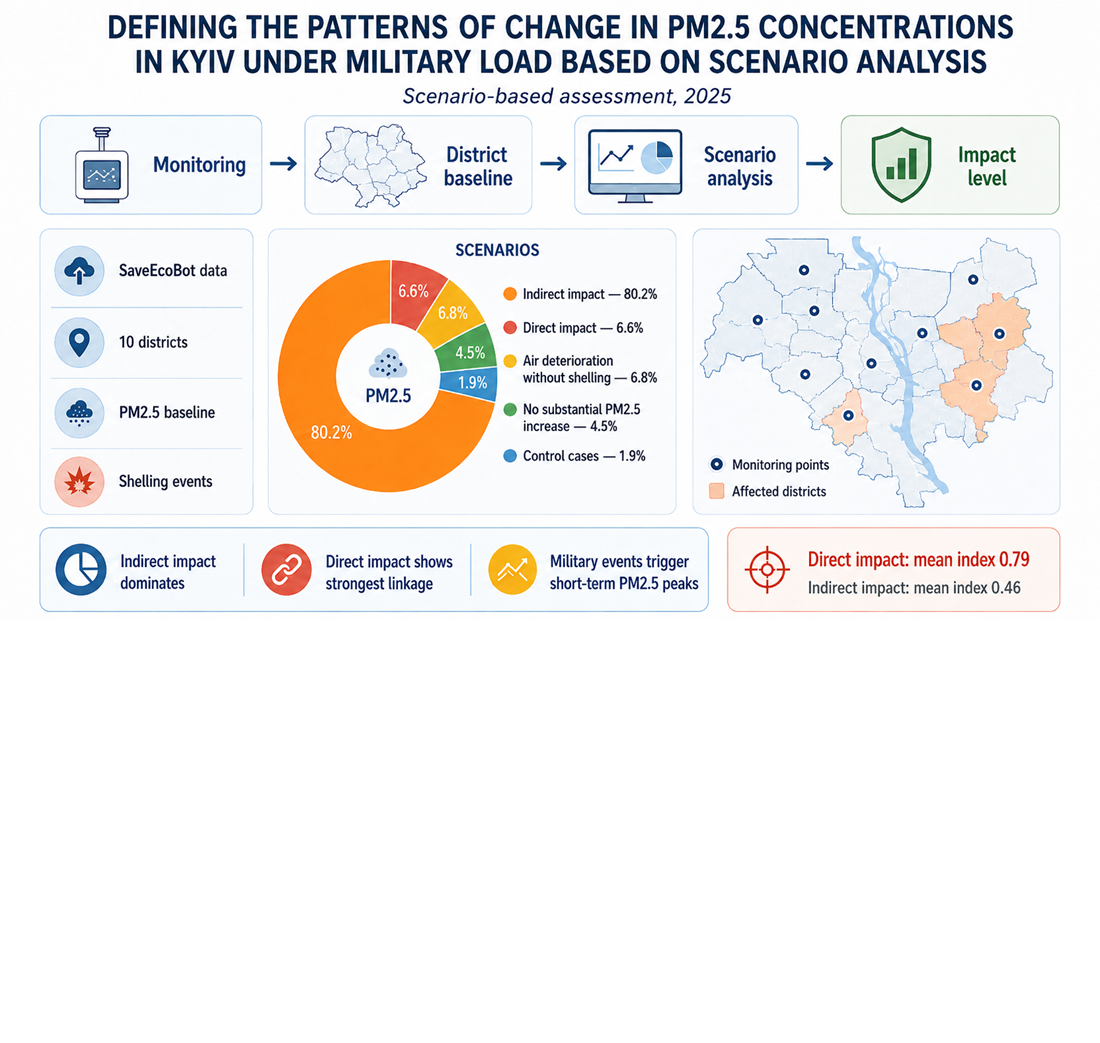
The work has assessed the impact of massive air attacks on the state of the atmospheric air in the city of Kyiv in 2025 based on the fine PM2.5 particles concentrations. The study used data from air quality monitoring networks aggregated at the SaveEcoBot platform (Ukraine), as well as information on the nature, intensity, and consequences of military events in the capital's districts.
An integrated scenario approach to assessing the relationship between shelling and changes in PM2.5 concentrations has been proposed, based on a combination of spatial, temporal, and event characteristics. The methodology takes into account the background values of PM2.5 concentrations for each district, as well as the type of local impact of military events. Within the model, scenarios of direct and indirect impact, deterioration of air quality without shelling, situations without a significant increase in PM2.5 and control cases were distinguished.
It was established that the largest share of observations (80.2%) is made up of cases of possible indirect impact – 340 episodes associated with the transfer of combustion products from the fire site and secondary aerosol pollution. For the category of direct possible impact, 28 cases (6.6%) were recorded at the highest average value of the integrated index of 0.79, which corresponds to a high level of connection between military events and deterioration of air quality. It has been shown that military events form short-term periods of extreme atmospheric air pollution.
The results of the study lay the groundwork for further integrated assessment of the combined impact of atmospheric, technogenic, and military factors on urbanized areas
References
- Rawtani, D., Gupta, G., Khatri, N., Rao, P. K., Hussain, C. M. (2022). Environmental damages due to war in Ukraine: A perspective. Science of the Total Environment, 850, 157932. https://doi.org/10.1016/j.scitotenv.2022.157932
- Pereira, P., Bašić, F., Bogunovic, I., Barcelo, D. (2022). Russian-Ukrainian war impacts the total environment. Science of the Total Environment, 837, 155865. https://doi.org/10.1016/j.scitotenv.2022.155865
- Harada, K. H., Soleman, S. R., Ang, J. S. M., Trzcinski, A. P. (2022). Conflict-related environmental damages on health: lessons learned from the past wars and ongoing Russian invasion of Ukraine. Environmental Health and Preventive Medicine, 27, 35. https://doi.org/10.1265/ehpm.22-00122
- van der Vet, F. (2024). A polluting war: Risk, experts, and the politics of monitoring wartime environmental harm in Eastern Ukraine. Environment and Planning C: Politics and Space, 42 (7), 1187–1206. https://doi.org/10.1177/23996544241229553
- Directive 2012/18/EU of the European Parliament and of the Council of 4 July 2012 on the control of major-accident hazards involving dangerous substances, amending and subsequently repealing Council Directive 96/82/EC Text with EEA relevance. http://data.europa.eu/eli/dir/2012/18/oj
- Necci, A., Krausmann, E. (2022). Introduction to eNATECH. Publications Office of the European Union. https://dx.doi.org/10.2760/88277
- Hnatiuk, V., Shabliy, T. (2025). Chemical hazard of the air component of Russia’s aggression. Proceedings of the NTUU “Igor Sikorsky KPI”. Series: Chemical Engineering, Ecology and Resource Saving, 1, 56–67. https://doi.org/10.20535/2617-9741.1.2025.325838
- Liquid Rocket Fuel in the OSCE Area: Overview of Disposal Aspects. Organization for Security and Co-operation in Europe (OSCE). Available at: https://www.osce.org/fsc/35905
- Kabinet ministriv Ukrainy. Rozporiadzhennia vid 28 lystopada 2012 r. No. 949-r Kyiv Pro zatverdzhennia pereliku komponentiv ridkoho raketnoho palyva, shcho pidliahaiut utylizatsiyi u 2013–2014 rokakh. Available at: https://zakon.rada.gov.ua/laws/show/949-2012-%D1%80#Text
- Kabinet ministriv Ukrainy. Rozporiadzhennia vid 18 liutoho 2015 r. No. 108-r Kyiv. Pro zatverdzhennia pereliku komponentiv ridkoho raketnoho palyva, shcho pidliahaiut utylizatsiyi u 2015 i 2016 rokakh. Available at: https://zakon.rada.gov.ua/laws/show/108-2015-%D1%80#Text
- Jiadan, D., Liqiao, T., Fang, C., Xiaobin, C., Xiaoling, C., Qiangqiang, X., Xinghui, X. (2023). Spatio-temporal variations of aerosol optical depth over Ukraine under the Russia-Ukraine war. Atmospheric Environment, 314, 120114. https://doi.org/10.1016/j.atmosenv.2023.120114
- Bulhakov, Y., Hnatiuk, V., Shabliy, T. (2026). Resilience of composite environmental safety indices under wartime conditions: sensitivity to methodology and the impact of statistical distortions. Eastern-European Journal of Enterprise Technologies, 1 (10 (139)), 6–21. https://doi.org/10.15587/1729-4061.2026.351699
- Bondar, K., Tsiupa, I., Virshylo, M. (2025). Monitoring Air Pollution in Wartime Kyiv (Ukraine): PM2.5 Spikes During Russian Missile and Drone Attacks. Urban Science, 9 (11), 477. https://doi.org/10.3390/urbansci9110477
- Boychenko, S. G., Karamushka, V. I., Khlobystov, Ie. V. (2025). Assessment of pollutants emissions into the atmosphere due to the fire at the Kalynivka oil depotcaused by a missile strike in March 2022. Geofizicheskiy Zhurnal, 47 (2). https://doi.org/10.24028/gj.v47i2.322465
- Rinaldi, S. M., Peerenboom, J. P., Kelly, T. K. (2002). Identifying, understanding, and analyzing critical infrastructure interdependencies. IEEE Control Systems, 21 (6), 11–25. https://doi.org/10.1109/37.969131
- Yashchenko, L., Androshchuk, O., Vasylenko, L., Chornoivan, Y. (2025). Environmental risks of heavy metal pollution in war-affected soils in Ukraine. European Journal of Environmental Sciences, 15 (1), 18–27. https://doi.org/10.14712/23361964.2025.3
- Solokha, M., Demyanyuk, O., Symochko, L., Mazur, S., Vynokurova, N., Sementsova, K., Mariychuk, R. (2024). Soil Degradation and Contamination Due to Armed Conflict in Ukraine. Land, 13 (10), 1614. https://doi.org/10.3390/land13101614
- Savenets, M. V., Dvoretska, I. V., Kozlenko, T. V., Komisar, K. M., Umanets, A. P., Zhemera, N. S. (2023). Status of atmospheric air pollution in Ukraine prior to the full-scale russian invasion. Part 1: ground-level content of pollutants. Ukrainian Hydrometeorological Journal, 31, 69–87. https://doi.org/10.31481/uhmj.31.2023.05
- Tsentralna heofizychna observatoriya imeni Borysa Sreznevskoho. Available at: http://cgo-sreznevskyi.kyiv.ua/uk/
- SaveEcoBot. Available at: https://www.saveecobot.com/static/about
- Rehionalna dopovid pro stan navkolyshnoho pryrodnoho seredovyshcha mista Kyieva u 2024 rotsi. Departament zakhystu dovkillia ta adaptatsiyi do zminy klimatu vykonavchoho orhanu Kyivskoi miskoi rady (Kyivskoi miskoi derzhavnoi administratsiyi). Available at: https://ecodep.kyivcity.gov.ua/ekolohichnyi-pasport-ta-rehionalna-dopovid/rehionalna-dopovid
- Ukraine - Fourth Rapid Damage and Needs Assessment (RDNA4) : February 2022 - December 2024 (English). Washington, D.C. World Bank Group. Available at: http://documents.worldbank.org/curated/en/099022025114040022
- Ukraine: Humanitarian Situation Snapshot (June - July 2025) [EN/UK]. United Nations Office for the Coordination of Humanitarian Affairs. Available at: https://www.unocha.org/publications/report/ukraine/ukraine-humanitarian-situation-snapshot-june-july-2025
- Live most polluted global major city ranking. Available at: https://www.iqair.com/us/world-air-quality-ranking
- SaveDnipro. Available at: https://www.savednipro.org/about
- Alves, C., Evtyugina, M., Vicente, E., Vicente, A., Rienda, I. C., de la Campa, A. S. et al. (2023). PM2.5 chemical composition and health risks by inhalation near a chemical complex. Journal of Environmental Sciences, 124, 860–874. https://doi.org/10.1016/j.jes.2022.02.013
- Sangkham, S., Phairuang, W., Sherchan, S. P., Pansakun, N., Munkong, N., Sarndhong, K. et al. (2024). An update on adverse health effects from exposure to PM2.5. Environmental Advances, 18, 100603. https://doi.org/10.1016/j.envadv.2024.100603
- Okupanty vypustyly po Ukraini 19 raket ta ponad 120 BPLA – Povitriani Syly ZSU. Available at: https://armyinform.com.ua/2025/02/11/okupanty-vypustyly-po-ukrayini-19-raket-ta-ponad-120-bpla-povitryani-syly-zsu/
- Kyiv air pollution spikes following June 17 Russian assault. RBC-UKRAINE. Available at: https://newsukraine.rbc.ua/news/kyiv-air-pollution-spikes-following-june-1750154550.html
Downloads
Published
How to Cite
Issue
Section
License
Copyright (c) 2026 Viacheslav Hnatiuk, Anastasiia Skliarova, Yuliia Kyrylenko, Dmytro Sidorov, Tetyana Shabliy

This work is licensed under a Creative Commons Attribution 4.0 International License.
The consolidation and conditions for the transfer of copyright (identification of authorship) is carried out in the License Agreement. In particular, the authors reserve the right to the authorship of their manuscript and transfer the first publication of this work to the journal under the terms of the Creative Commons CC BY license. At the same time, they have the right to conclude on their own additional agreements concerning the non-exclusive distribution of the work in the form in which it was published by this journal, but provided that the link to the first publication of the article in this journal is preserved.
A license agreement is a document in which the author warrants that he/she owns all copyright for the work (manuscript, article, etc.).
The authors, signing the License Agreement with TECHNOLOGY CENTER PC, have all rights to the further use of their work, provided that they link to our edition in which the work was published.
According to the terms of the License Agreement, the Publisher TECHNOLOGY CENTER PC does not take away your copyrights and receives permission from the authors to use and dissemination of the publication through the world's scientific resources (own electronic resources, scientometric databases, repositories, libraries, etc.).
In the absence of a signed License Agreement or in the absence of this agreement of identifiers allowing to identify the identity of the author, the editors have no right to work with the manuscript.
It is important to remember that there is another type of agreement between authors and publishers – when copyright is transferred from the authors to the publisher. In this case, the authors lose ownership of their work and may not use it in any way.








